Tag Archives: Quote of the Day

Quote of the Day

Image result for bertrand russell

“For the love that has been purged by gentleness of all tendency towards tyranny can give a joy more exquisite, more tender, more capable of transmuting the base metal of daily life into the pure gold of mystic ecstasy, than any emotion that is possible to the man still fighting and struggling to maintain his ascendency in this slippery world.”

I love smart people. Deconstructing the sage words of people like Bertrand Russell (1872-1970) is like trying to put together a jigsaw puzzle – for a blind person.

Now, seriously, who doesn’t love a man with a pipe in his mouth and a tweed jacket to boot? The answer? Nobody. In fact, it’s hard to find stock images of  Bernie R. (no one actually called him that) without a good ol’ pipe dangling from those luscious and lascivious lips of his.

Born before the invention of the freaking electric light bulb, the automobile, the airplane, and, obviously, the iPhone, Russell would also outlive notable contemporaries like Winston Churchill, Adolf Hitler, FDR, Eleanor Roosevelt, Marie Curie, Ernest Hemingway, Mahatma Gandhi and Albert Einstein.

I like this Quote of the Day because, like Russell himself, it’s multilayered and multifaceted. Mathematician, philosopher, educator, writer, historian and political activist, B.R. was also a Nobel Laureate in his lifetime. Yep, just another trophy for the mantle.

With the above quote, you can see his mind at work on so many levels: as a poetic musing on love; as the opening of a treatise on overcoming political oppression; as a scientific analogy to everyday survival; and as a basic guideline to achieving happiness.

Oh, and in case you were wondering, today’s quote comes from Bertrand Russell’s 1930 book The Conquest of Happiness.

Leave a comment

Filed under Uncategorized

Quote of the Day

Image result for the end of history and the last man

“This then was the ultimate goal of totalitarianism: not simply to deprive the new Soviet man of his freedom, but to make him fear freedom in favor of security, and to affirm the goodness of his chains even in the absence of coercion.”

People like author Francis Fukuyama make my head hurt. Not in that John Cougar Mellencamp “make it hurt so good” kind of way; more in that “someone is using a jackhammer on my brain” sort of thing.

Fukuyama’s The End of History and the Last Man is one of the most engaging and informative non-fiction books I’ve read on political history. I’d sum up the book myself, but I’m feeling lazy, read the book years ago, and stumbled upon a review on goodreads.com that does a nice job of simplifying an otherwise big book.

Per the goodreads reviewer known only as Hadrian:

“[Fukuyama] does start off with the bold assertion that liberal-capitalist-democracy is the end point of history, but uses the rest of his chapters to back off from this assertion into a more tepid series of observations.

He does not support liberal-capitalist-democracy from a moral grounding, but instead notes its ability to survive and continue to reproduce itself after repeated economic crises, and its ability to outlast other alternatives from the far-right (fascism), and the far-left (communism). Its status as part of the end of history is taken from Hegel, interpreted by Kojeve and a bit of Kant. Fukuyama draws on these to say that the overall ‘meaning’ of history itself, or at least the general trend of it, leads to the continued spread of liberal-capitalist-democracy, and its perceived effectiveness in allowing the individual to act and express according to their own personal liberties in a universal, if homogeneous, state.

Despite this, it is still easy to pick apart his argument. The greatest possible drawback is that the historical conditions which led to the spread of liberal-capitalist-democracy might not necessarily continue into the 21st century and beyond. A chief example among these is the economic catastrophe of 2007, and how many have perceived this international system has being unable to meet the needs of its citizens.”

Now, if Mr. Fukuyama were to create some new idioms in the context of the current political climate in Washington, I imagine he might come up with one or more of the following zingers:

  • If it ain’t broke, don’t trump it.
  • You don’t be down with my there interpret of the constitutions, you be don with the wind.
  • My hair, my hair! My kingdom for my hair!
  • I vanka answer your question, dumbass, but I also vanka get me a piece of *$%&.
  • My mind thinks alike, small minds are for the (mostly immigrant) peons.
  • Be the change you will force on the world.
  • Money is the root of which all trees grow across America. Except in the blue states, where they grow on fake news, corruption, “facts,” liars, despicable people, evil lifestyles and rational intercourse (sic)

Leave a comment

Filed under Uncategorized

Quote of the Day

Image result for absolute mayhem, craziness

“[H]uman consciousness has been reduced to a panicked blur, a zoetrope of galloping despair.”

I love this line! I didn’t even know what on god’s green earth a “zoetrope” was before reading it this morning and I STILL loved it. Awesomeness as its most awesome.

This quote comes from an op-ed by Lindy West in The Guardian yesterday called “The first 25 days of Trump have been a zoetrope of galloping despair.” The preamble is as follows:

Today, during my morning routine of opening my laptop, clicking on literally anything, and just screaming and screaming, I made the astonishing discovery that Donald Trump has only been president of the United States for about three weeks. Which is weird, because I could have sworn we had fallen through a tesseract into the airless crush of a two-dimensional void at least seven eternities ago, or what would have constituted seven eternities if such a place had a linear concept of time. Turns out, though, it has only been 25 days, we are still on earth, and every cell in my body has not been excruciatingly flattened into pure math. It just feels like it.

It’s an understandable mistake, I think. Trump has really been eat-pray-loving his way through his first month as the most dangerous man on earth, seeding so many potential atrocities – including, perhaps, the breakdown of the republic itself – that human consciousness has been reduced to a panicked blur, a zoetrope of galloping despair. There are simply too many emergencies to hold all of them in your mind at once. Cecily Strong captured the feeling on this week’s Saturday Night Live: “Let me just say, you’re doing too much. I want one day without a CNN alert that scares the hell out of me.”

Spicy Spice might like using dolls to explain things to the media on a certain TV show, but with Donnie T. I think his pictures speak more words than any painter at anytime in history could ever evoke if not for the T.’s sage choice in art.

I’m not really sure what that means exactly, but here goes my poor attempt to capture the essence of it.

This is your brain.

Image result for the human brain

This is your brain in the Donnie T. era

Image result for chaos


Leave a comment

Filed under Uncategorized

Quote of the Day

Image result for valentine's day

In honour of Valentine’s Day, I present to you some literary gems about that mysterious, all-encompassing, ever-absorbing, selflessly selfish and painfully blissful notion we in English call  Image result for love sculpture.


“The most painful thing is losing yourself in the process of loving someone too much, and forgetting that you are special too.”
Ernest Hemingway, Men Without Women

“If all else perished, and he remained, I should still continue to be; and if all else remained, and he were annihilated, the universe would turn to a mighty stranger.”
Emily Brontë, Wuthering Heights   

“Have enough courage to trust love one more time and always one more time.”
Maya Angelou

“Love is an irresistible desire to be irresistibly desired.”
Robert Frost

And finally, from the master of the written word himself:

“Let there be spaces in your togetherness, And let the winds of the heavens dance between you. Love one another but make not a bond of love: Let it rather be a moving sea between the shores of your souls…For only the hand of Life can contain your hearts. And stand together, yet not too near together: For the pillars of the temple stand apart, And the oak tree and the cypress grow not in each other’s shadow.”
Kahlil Gibran, The Prophet

4 Comments

Filed under Uncategorized

Quote of the Day

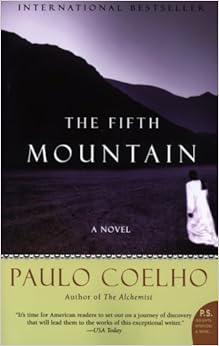
Image result for the fifth mountain

“At this moment, many people have stopped living. They do not become angry, nor cry out; they merely wait for time to pass. They did not accept the challenges of life, so life no longer challenges them.”

Although Brazilian author Paulo Coelho intrigued me with this breakout novel, The Alchemist, which in many ways is a modern-day The Little Prince, as I began to read more of Coelho’s works I quickly discovered that his formulaic, sometimes trite plotlines had begun to grow tiresome. His very left-leaning, staunch Catholic view of the world surfaced in ways that made his novels read more like platforms for personal rhetoric (and not unlike Trump’s use of Twitter) than creative fiction.

However, that’s not to say that Coelho can’t pen some snappy sentences from time to time. In fact, I think that’s his greatest gift as a writer; he is to memorably, thought-provoking short bursts of prose what Mad Men are to sound bites on Madison Avenue.

In any event, The Fifth Mountain was the fifth – and final – Coelho novel I read and will most likely ever read, but it did have the one passage quoted above that I felt, and still feel, is relevant to people’s lives today. While it’s true that we all face challenges in life, not all of us step up to confront them. Or, more to the point, we don’t challenge ourselves to become better human beings, to soar higher, faster, stronger. We merely let the sands of time wash over us in a desert of unfeeling numbness, head buried firmly underground, and waiting for this shitshow called life to be over.

Perhaps that sounds harsh, but I think Coelho would agree, and is part of the reason he’s been so successful. Like him or not, he’s taken life by the horns and run with the bulls all the way to the bank, selling more than 350 million books worldwide in more than 80 languages. Not bad for a law school dropout and self-described “hippie” who spent his early adult years traveling and not doing much of anything when it came to work.

Leave a comment

Filed under Uncategorized

Quote of the Day

Image result for a gesture life

“And the idea entreats me once more, to wonder if something like love is forever victorious, truly conquering all, or if there are those who, like me, remain somehow whole and sovereign, still love unvanquished.”

Today’s Quote of the Day comes from my favourite Chang-rae Lee novel, A Gesture Life. Although best known for his debut novel, Native Speaker (winner of the PEN/Hemingway Foundation Award and the American Book Award), A Gesture Life is a beautiful work of fiction that mixes lyrical, song-like prose with the hardship of reflecting back on a life that is wrought with tragedy and fatal mistakes.

The story switches back and forth between  the past and present and does so to overwhelming success. The protagonist, a Korean-born Japanese man named Doc Hata, eventually settles in New England later in life, but he has a dark secret that involves something very few Europeans and North Americans know much about: World War II comfort women. The majority of these women were Korean, though there were also Chinese, Taiwanese and even Dutch nationals (living in Indonesia) who were essentially sex slaves used by the Imperial Japanese Army in their march across Asia. They typically lived “in harsh conditions, where they were subjected to continual rapes and were beaten or murdered if they resisted.”

In A Gesture Life, the reader is transported to Burma (or Myanmar as it’s now known) near the end of the war through Doc Hata and the writing pops off the page with its authenticity and pathos. Yet it’s the slow revelations much later in Doc Hata’s life that lends the book a quiet mysteriousness that for me still resonates to this day.

If you’ve never read anything before by the Stanford creative writing professor, I strongly encourage you to start with this novel. You won’t regret it.

Leave a comment

Filed under Uncategorized

(Sports) Quotes of the Day

Image result for super bowl 2017

In honour of today’s 51st Super Bowl, otherwise known as the “Li Bowl,” I thought I’d switch gears and list some memorable sports quotes from the past. Although they come from athletes and coaches in different sports, one common thread – the resounding message, really –  is this: never give up; never quit; play on until you fall over or else die.

On that note, I present 11 inspirational sports quotations.

“There are only two options regarding commitment. You’re either IN or you’re OUT. There is no such thing as life in-between.” – Pat Riley

“A champion is someone who gets up when he can’t.” – Jack Dempsey
“It ain’t over till it’s over.” – Yogi Berra
“You’re never a loser until you quit trying.” – Mike Ditka
“Never give up! Failure and rejection are only the first step to succeeding.” – Jim Valvano
“You miss 100 percent of the shots you don’t take.” – Wayne Gretzky


“The highest compliment that you can pay me is to say that I work hard every day, that I never dog it.” – Wayne Gretzky

“Gold medals aren’t really made of gold. They’re made of sweat, determination, and a hard-to-find alloy called guts.” – Dan Gable

“I’ve missed more than 9,000 shots in my career. I’ve lost almost 300 games. 26 times, I’ve been trusted to take the game winning shot and missed. I’ve failed over and over and over again in my life. And that is why I succeed.” Michael Jordan
“It’s not whether you get knocked down; it’s whether you get up.” – Vince Lombardi

1 Comment

Filed under Uncategorized

Quote of the Day

Image result for long walk to freedom

Before the term “bucket list” became oh so chi-chi and pervasive throughout society here in the NA, I had vowed as a young man to one day travel to South Africa and somehow meet Nelson Mandela.  In 2009, I accomplished the former, but sadly not the latter. Four years later Madiba would be gone.

Just as with Mahatma Gandhi’s passing in 1948, the world felt a little colder, a little darker that December day when Mr. Mandela left us. It’s rare that there’s more than one towering figure of humanity every generation, a person who so captures the imagination and respect of the entire world, a man or woman who inspires not a country or a religion or an ethnicity, but the whole of the human race. Nelson Mandela was one of these unforgettable historical figures.

In light of the current political volatility gripping much of the planet –  from the Boko Haram insurgency in Africa to the immigration disaster unfolding in Europe, from the rise of ISIS in the Middle East to the birth of a new intolerance in the world’s most powerful country – I look to extraordinary leaders both past and present for inspiration. Today, I turn to Nelson Mandela and his autobiography, Long Walk to Freedom.

A man who takes away another man’s freedom is a prisoner of hatred, he is locked behind the  bars of prejudice and narrow-mindedness. I am not truly free if I am taking away someone else’s freedom, just as surely as I am not free when my freedom is taken from me. The oppressed and the oppressor alike are robbed of their humanity.

Leave a comment

Filed under Uncategorized

Quote of the Day

Image result for the wind-up bird chronicle

Is it possible, in the final analysis, for one human being to achieve perfect understanding of another? We can invest enormous time and energy in serious efforts to know another person, but in the end, how close can we come to that person’s essence? We convince ourselves that we know the other person well, but do we really know anything important about anyone?

In the spirit of what Facebook yesterday called Happy Friends Day, I thought it apropos to quote something about friendship and ended up stumbling on Murakami Haruki’s The Wind-up Bird Chronicle. However, unlike almost all the other quotes I use as part of this series, I have to say that I vehemently disagree with it. Whether this passage is exclusively the belief of the book’s protagonist, Toru Okada, or of Murakami himself, either way I don’t buy in to it.

Although Murakami’s characters tend to sway more to the cynical side of things, usually it’s not a “hot issue” (Norwegian Wood is a prime example). Perhaps it’s a cultural difference? Maybe it’s a trait of Murakami’s characters? I don’t know for sure, but what I do believe is that if you don’t “know anything important about anyone,” you don’t have what the Koreans call nunchi (눈치) and the Japanese call kidzui (気づい), which is essentially an emotional quotient high enough to read others’ feelings and mood.

It’s not about knowing  the most number of secrets about a friend, for example, that makes you close. It’s understanding their inner workings, sympathizing with what you share in common, while empathizing when unable to relate directly. In the case of Toru Okada and The Wind-up Bird Chronicle, I think this passage actually works because here’s a guy whose wife walks out on him one day out of the blue while going to look for their cat, never to return.  After a series of encounters with some legendary supporting characters (May Kasahara, Lieutenant Honda, Creta and Malta Kano, Nutmeg and Cinnamon Akasaka and, of course, the legendary Boris the Skinner), the only contact he’ll ever have again with his wife is through this dark, cold, emotionless machine called a computer (remember Murakami was writing this novel before most people knew what the word email meant).

In any event, the passage may work for the novel and a cynical protagonist, but is not reflective of what friendship should be or can be. As my brother likes to say, “Friends are friendly!” Ergo, friendliness is next to…err…godliness?

Leave a comment

Filed under Uncategorized

Quote of the Day

Image result for robert fulghum

I mentioned the author Robert Fulghum in a post the other day, and would be remiss if I didn’t include his most famous quote as part of this series.

All I Really Need To Know I Learned in Kindergarten was first published in 1986 to great commercial success, but not nearly as much critical praise. Apparently some critics called it “trite” and “saccharine,” which is just a fancy way of saying way, way over-the-top mushy.

Whatever the case, I enjoyed reading this book many moons ago, and I don’t think Fulghum ever pretended to make this a philosophical treatise like Kahlil Gibran’s The Prophet. I think his point – at least in this book – is that as we grow older we tend to complicate the simple and forget that the most important lessons are the most basic ones we learn as children. Period. End of story.

On that note, I present Mr. Fulghum’s most famous quote from a literary career that has seen him sell 16 million copies of his books in 27 languages.


Share everything.

Play fair.

Don’t hit people.

Put things back where you found them.

Clean up your own mess.

Don’t take things that aren’t yours.

Say you’re sorry when you hurt somebody.

Wash your hands before you eat.

Flush.

Warm cookies and cold milk are good for you.

Live a balanced life – learn some and think some
and draw and paint and sing and dance and play
and work every day some.

Take a nap every afternoon.

When you go out into the world, watch out for traffic,
hold hands, and stick together.

Be aware of wonder.
Remember the little seed in the styrofoam cup:
The roots go down and the plant goes up and nobody
really knows how or why, but we are all like that.

Goldfish and hamsters and white mice and even
the little seed in the Styrofoam cup – they all die.
So do we.

And then remember the Dick-and-Jane books
and the first word you learned – the biggest
word of all – LOOK.

Everything you need to know is in there somewhere.
The Golden Rule and love and basic sanitation.
Ecology and politics and equality and sane living.

Take any of those items and extrapolate it into
sophisticated adult terms and apply it to your
family life or your work or your government or
your world and it holds true and clear and firm.
Think what a better world it would be if
all – the whole world – had cookies and milk about
three o’clock every afternoon and then lay down with
our blankies for a nap. Or if all governments
had a basic policy to always put things back where
they found them and to clean up their own mess.

And it is still true, no matter how old you
are – when you go out into the world, it is best
to hold hands and stick together.

Leave a comment

Filed under Uncategorized