Attention all fringe artists. The Toronto Fringe Festival, otherwise known as the @Toronto_Fringe TD Culturally Diverse Artist Project (CDAP), is taking place from July 5-16, 2017. Click on the previous link and learn more about how to apply and if you qualify for a bursary.
Category Archives: Uncategorized
Quote of the Day
![]()
In the wake of all the new rules breaking down art into different categories, I’m stretching the limits a la Swedish, too. That’s why today’s Quote of the Day is a poem, William Blake’s “On Another’s Sorrow.” If you don’t think an 18-stanza poem is a quote, take it up with the Swedish Academy.
Said beautiful work of poetry was published in 1789 by Blake in his Songs of Innocence and Experience. Per the mighty Wiki, “The poem discusses human and divine empathy and compassion. It was published…as the last song in the Songs of Innocence section. Blake argues that human sympathy is a valuable trait. After making this observation about man he then speaks of the sympathy of God, as well.”
Can I see another’s woe,
And not be in sorrow too?
Can I see another’s grief,
And not seek for kind relief?
Can I see a falling tear,
And not feel my sorrow’s share?
Can a father see his child
Weep, nor be with sorrow filled?
Can a mother sit and hear
An infant groan, an infant fear?
No, no! never can it be!
Never, never can it be!
And can He who smiles on all
Hear the wren with sorrows small,
Hear the small bird’s grief and care,
Hear the woes that infants bear –
And not sit beside the nest,
Pouring pity in their breast,
And not sit the cradle near,
Weeping tear on infant’s tear?
And not sit both night and day,
Wiping all our tears away?
O no! never can it be!
Never, never can it be!
He doth give His joy to all:
He becomes an infant small,
He becomes a man of woe,
He doth feel the sorrow too.
Think not thou canst sigh a sigh,
And thy Maker is not by:
Think not thou canst weep a tear,
And thy Maker is not near.
O He gives to us His joy,
That our grief He may destroy:
Till our grief is fled and gone
He doth sit by us and moan.
Can I see another’s woe,
And not be in sorrow too?
Can I see another’s grief,
And not seek for kind relief?
Can I see a falling tear,
And not feel my sorrow’s share?
Can a father see his child
Weep, nor be with sorrow filled?
Can a mother sit and hear
An infant groan, an infant fear?
No, no! never can it be!
Never, never can it be!
And can He who smiles on all
Hear the wren with sorrows small,
Hear the small bird’s grief and care,
Hear the woes that infants bear –
And not sit beside the nest,
Pouring pity in their breast,
And not sit the cradle near,
Weeping tear on infant’s tear?
And not sit both night and day,
Wiping all our tears away?
O no! never can it be!
Never, never can it be!
He doth give His joy to all:
He becomes an infant small,
He becomes a man of woe,
He doth feel the sorrow too.
Think not thou canst sigh a sigh,
And thy Maker is not by:
Think not thou canst weep a tear,
And thy Maker is not near.
O He gives to us His joy,
That our grief He may destroy:
Till our grief is fled and gone
He doth sit by us and moan.

Filed under Uncategorized
OAC Premier’s Awards for Excellence in the Arts
If you know of an artist or arts organization that should be nominated for this highly prestigious (and financially lucrative) award, make sure you nominate them through the Ontario Arts Council by December 1, 2016.
Filed under Uncategorized
It’s All in Your Head
Talk about taking Edvard Munch’s The Scream to the next level!
Jowita Bydlowska, author of the controversial memoir Drunk Mom, posted a thought-provoking (if you’re not an artist) and thoroughly frightening (if you are an artist) piece on the correlation between mental health/addiction/suicide and the artistic process on alllitup.ca called “So you’re an artist? Help is on the way! ”
Congrats to Jowita for the buzz she’s created with the recent release of her first novel, Guy, which The Globe and Mail recently reviewed and said is not only “fascinating and disturbing,” but “a timely study into…[a] toxic and predatory masculinity.”
Filed under Uncategorized
Quote of the Day
Oh, to have a first and last name that match! For Jerome K. Jerome, he was one of the lucky blokes. Perhaps that’s what gave him his first insight into humourous writing. Just look at this humdinger from his 1899 travel guide turned comedic account, Three Men in a Boat, which chronicles a two-week jaunt along the River Thames. Jerome and two of his chaps, “martyrs to hypochondria and general seediness,” are sure to have you Rolling On The River Thames Laughing with zingers like this one:
“It is not that I object to the work, mind you; I like work: it fascinates me. I can sit and look at it for hours.”
Filed under Uncategorized
Quote of the Day
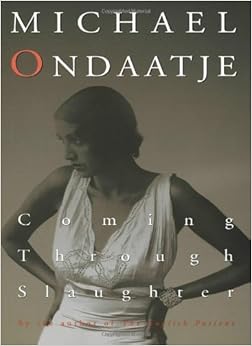
While not his most famous literary achievement, Michael Ondaatje is money in the bank when it comes to beautiful prose regardless of the work you’re reading. The selection below is from Coming Through Slaughter, Ondaatje’s debut work of fiction about legendary cornet player Buddy Bolden, and the same book that would go on to win Amazon.ca’s First Novel Award for 1976.
In a week marred (yes, marred) by Nobelgate, it still confounds me that Mr. Ondaatje has (a) not won a Nobel Prize in Literature to date, and (b) wasn’t even in the running this year. (According to an article by Russell Smith in last week’s Globe and Mail, “The Japanese novelist Haruki Murakami was the leader at 4/1, followed by people such as Syrian poet Adonis, Kenyan Ngugi wa Thiong’o and Albanian Ismail Kadare. The only American writers who were considered even a possibility were the cerebral and serious Philip Roth and Don de Lillo.”)
But without further ado, here’s just one example (among thousands) of how Michel Ondaatje bends the English language to his will, effortlessly, it seems, in ways mere mortals like myself could never hope to accomplish.
“Accidental lust on the bus carrying her new into his dead brain so even months later, years later, pieces of her body and character returned. What he wanted was cruel, pure relationship.”
Filed under Uncategorized
Quote of the Day
Fewer passages have resonated with me as much on a personal level than this one below from Somerset Maugham’s “masterpiece” (as some claim), Of Human Bondage (1915). Considered one of the greatest novels of the 20th century by Modern Library, many said upon its release that it was essentially a retelling of Maugham’s own life experiences, to which Maugham replied, “This is a novel, not an autobiography, though much in it is autobiographical, more is pure invention.” Whatever the case, it’s an intense and compelling story about what Spinoza called the “Strength of Human Emotions” in his philosophical treatise, Ethics.
“There is nothing so degrading as the constant anxiety about one’s means of livelihood. I have nothing but contempt for people who despise money. They are hypocrites or fools. Money is like a sixth sense without which you cannot make a complete use of the other five. Without an adequate income half the possibilities of life are shut off…You will hear people say that poverty is the best spur to the artist. They have never felt the iron of it in their flesh. They do not know how mean it makes you. It exposes you to endless humiliation, it cuts your wings, it eats into your soul like a cancer.”
Filed under Uncategorized
Upcoming OAC Grant Deadlines
Attention all artists residing in Ontario! There are a number of Ontario Arts Council (OAC) grant deadlines approaching in many different artistic disciplines. Click here to see if you meet the requirements for any of them.
Filed under Uncategorized
Quote of the Day
In the wake of Nobelgate, Anna North at The New York Times printed a well-crafted response to the decision to give this year’s Prize in Literature to Bob Dylan. Although argued from a slightly different point of view than my own post yesterday, it essentially resonates with the same message: The Swedish Academy got it wrong. Badly.
But instead of focusing on the negative, I thought I’d offer some examples of poetic literary quotes over the few next few days to remind us all of the power and inspiration behind the written word.
This one comes from the hugely talented British expat writer Lawrence Durrell (1912-90), whose most famous tetralogy of works, The Alexandria Quartet, includes some of the most beautiful writing I’ve read. Here’s a taste of TAQ #1, Justine:
“[F]alling in love…is a simultaneous firing of two spirits engaged in the autonomous act of growing up. And the sensation is of something having noiselessly exploded inside each of them. Around this event, dazed and preoccupied, the lover moves examining his or her own experience; her gratitude alone, stretching away towards a mistaken donor, creates the illusion that she communicates with her fellow, but this is false. The loved object is simply one that has shared an experience at the same moment, narcissistically; and the desire to be near the beloved object is at first not due to the idea of possessing it, but simply to let the two experiences compare themselves, like reflections in different mirrors…from here love degenerates into habit, possession, and back to loneliness.”
Filed under Uncategorized


Purchase your copy online from


You must be logged in to post a comment.