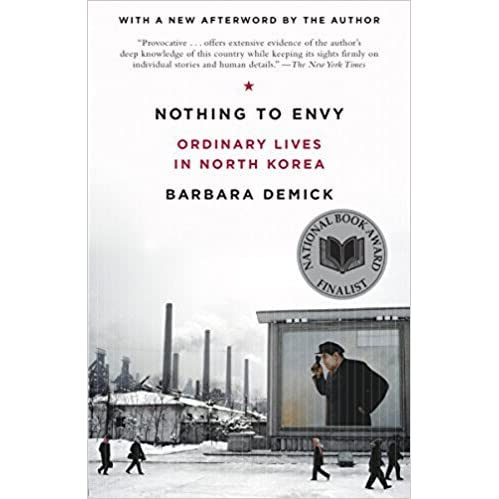
Nothing to Envy: Ordinary Lives in North Korea

A great title for a great book. Although the title (presumably) comes from one of the many propaganda signs found ubiquitously around North Korea (세상에 부럼 없어라 – We have nothing to envy in the world.), it could very well be a welcome sign at the “international” airport in Pyongyang, the country’s capital city.

The author of Nothing to Envy: Ordinary Lives in North Korea, award-winning journalist Barbara Demick, does a commendable job of getting six North Korean defectors from in and around the Chongjin (청진) area to open up about their lives, the lives of their family members and friends, and the lives of those around them while they were citizens of the Hermit Kingdom 2.0 and then after they arrive in South Korea. Even the most uninterested non-Koreaphiles will be turning the page and wanting more because it’s no different than reading a (real-life) modern-day version of Orwell’s 1984.

What really sets this book apart is the way the author constructs the narrative of the North Koreans who have escaped the ravages of life under Kim Il-sung and subsequently under Kim Jong-il. The fancy way of putting it is that Demick combines a Greek approach to tragedy through the predicaments these people face and the weaknesses which hold them back from successfully overcoming these challenges with a more modern tradition of making them human, fettered by flaws that are relatable and evoke anguish-filled empathy, with irony dripping over it all at pretty much every turn.

We want to scream out loud as these victims of a state-run campaign to destroy them in every facet of their lives keep telling themselves how great Kim Il-sung is, how great life is in North Korea, and how great everything will be once the rest of the world catches up to them technologically, politically and morally.

Even as people are dropping dead all around them during the Great Famine of the 1990s, it’s “Let’s stay strong on this Arduous March!” Just go! we want to tell these people. Get the hell out of Dodge! Cross the bloody Tumen River and then find a way — any way — to South Korea.

The most memorable revelations in this book are simple everyday moments that make you, the reader, pause for a few heartbreaking seconds and go, Holy shit. There really is a hell on Earth. For me, some of these moments included a woman collapsing as she entered China, falling to the ground, and discovering that the Chinese feed their dogs better, more nutritious food than the North Korean government did its own citizens; a highly educated defector getting to South Korea, reading 1984, and wondering how Orwell nailed it so perfectly years before this nightmare unfolded in North Korea; and hearing Kim Jong-il’s real voice through an illegal TV broadcast and realizing exactly what the Japanese did on August 15, 1945 — that small, tiny, weak voice was what we cowered under for a lifetime?

If you like learning and you enjoy a good ol’ tragedy, you will love this book. It is replete with so many of the most human of traits: through its pages we find first love, we please our parents and strive for the very best, we work hard and have big dreams of success and children and food on the table — and then we have it all obliterated. At the very least, it’s proof that the best of humanity does triumph in the face of unimaginable adversity. And while love may not always conquer every foe — real or imagined — it does propel us to new heights, it does inspire us to achieve the unachievable, and even when it does die a sad, lonely death, we are left with an enduring feeling that we are better people for having loved at all.

2 Comments

Filed under Uncategorized

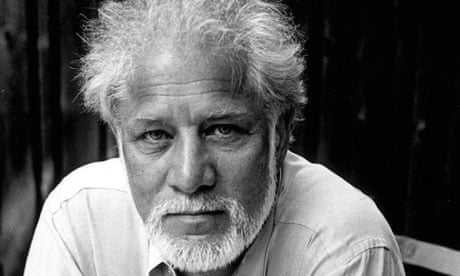
Michael Ondaatje

Michael Ondaatje: The divided man | Michael Ondaatje | The Guardian

Trust me, this will take time, but there is order here, very faint, very human. Meander if you want to get to town.

If you spend enough time outside of Canada as a Canadian, you’re bound to have a conversation with an American that goes something like this at least once in your life:

– “So where you from?”

– “Canada.”

– “No way! Do you know a guy named Tom? I forget his last name, but I think he’s from Saskatoon. Or…wait. No. What state is Saskatoon in?”

In any event, I may have inadvertently proven that stereotype true last week when I ran into Michael Ondaatje while out for a walk in my neighbourhood. Of course I ran into the 1992 Booker Prize winner, nay, the 2018 Golden Man Booker recipient. Just another day at the office here in the Saskatoon of Ontario. And of course I reminded him that he had won both those awards. You know, in case those trivial facts had slipped his mind

For those who know me, they will also know how much I venerate Mr. Ondaatje. I like to think — think — I keep my shit together with the best of them in stressful situations, but the author of what I have openly declared the most important work of fiction in the 20th century (The English Patient) brought out the ohmygodshootmeinthefacerightnow shakes in me. And he’s all cool, like, Ya, I’m a good-lookin’ dude and write like the badass yo’ mama told you to stay away from ’cause there’s a trick with a knife I’m learning to do. (I think he wrote something along those lines in The Collected Works of Billy the Kid.)

But I digress. After sheepishly asking him if he was indeed Michael Ondaatje, and he confirmed said fact, we talked for a few minutes. I gather he sensed my excitement (i.e. I was going slightly insane in the membrane) and he rewarded me for this boyish ebullience by showing off his dashing smile now and again as I basically listed off his accomplishments to him like a humanoid version of LinkedIn. Before we went our separate ways, he extended his hand for me to shake. Two equals we are not, but shake my hand like an equal he did.

Later, like a teenage dickwad fresh off his first date, I played the conversation over in my mind a million times when I got back home. Was I too direct? Did I come off too macho? Too lame? Did he notice that I’d had my hair cut yesterday? And why the hell did I wear those piece-of-crap shoes otherwise known as Zellers Specials from the 1980s!

It goes without saying that he noticed none of this shit. Why? He’s Michael god damn Ondaatje. As one of my hockey coaches used to say to us young fawns when we got caught in the proverbial headlights of life: “Get yer head outta yer ass and keep yer fackin’ stick on the ice, man!”

Here’s the thing. I don’t look up to a lot of people. Fewer still if them being alive and kicking is a prerequisite. It’s not likely Michael and I will ever be BFFs, which in my own brain seems incongruous because I know so much about him. And that’s because we form a different relationship with authors than we do with other artists. We don’t, for example, spend four minutes listening to their genius or two hours watching them weave their magic on screen or consider their message in those fleeting seconds or minutes we take in their brilliance at a museum.

No, we spend days and weeks and months and years with authors. They carve a unique pattern into the complicated fabric of our hearts and minds, distinct niches where no one else gets to go but them. Well, them and us. ‘Cause we’re a team. Together, we intimately know the “bodies we have plunged into and swum up as if rivers of wisdom, characters we have climbed into as if trees, fears we have hidden in as if caves.” Then we share these feelings and memories with friends, loved ones — even strangers on the Internet.

This relationship is more than special and beyond reproach. And that’s because we’ve gone through so much together! We totally get it when Patrick says he “never believed that characters lived only on the page…Each character had his own time zone, his own lamp…” Shit, me and Ondaatje carried Katharine Clifton’s body out into the desert together, “where there is the communal book of moonlight.” We got behind the wheel of a car with Hana, “under six stars and a moon,” because “Each person had their moment when they assumed the skins of wild animals, when they took responsibility for the story.” And guess what (we want to whisper to Hana)? Your turn is about to come up in an Italian monastery.

Along the way we even came through slaughter together before having a bunch of “conversations” with Walter Murch about a film that would take home nine Academy Awards. Man alive, we’ve been on more than one tour through World War II together, smelled the Cinnamon Peeler’s Wife, and returned to Sri Lanka, where our guide and author was born, after being away for many, many years, thank you very much, Anil.

We bums from the slums will always question how we come across to those whom we gaze at through refracted beams of broken sunlight. We know we’re idiots and usually do a pretty convincing job of coming across exactly that way to the person in question. Why do we do this? I have a feeling somebody already has the answer: “New lovers are nervous and tender, but smash everything. For the heart is an organ of fire.”

Did Ondaatje think I was mentally unfit and in need of some serious electroconvulsive therapy when I whipped off his “We die containing a richness of lovers and tribes” segment of The English Patient to his face? Me, the god damn reader, reciting the author’s own words to him on a moonlit street like we’re a couple of long-lost chums out for a poetic riff off. Seriously, who does that?

But I digress. Yet again. I’m good like that. I’ll leave this horrible attempt at a love letter from afar by quoting someone with a lot more mileage in the world of literature than I, George Bowering. In Jean-Michel Lacroix’s Re Constructing The Fragments of Michael Ondaatje’s Works, the 87-year-old Bowering penned a chapter titled “Once Upon a Time in the South: Ondaatje and Genre.” Aside from being a worthy read and wonderful insight into Ondaatje’s writing, George Bowering starts with an introduction that, in the opinion of someone who excels in douchebaggery, captures the wonder and paradox of a true national treasure here in Canada:

Michael Ondaatje is the plainest of men. He never has a decent haircut. He wears jeans that look like two blue bags. His favourite movie is a spaghetti western. It takes him years and years of painstaking assembly to write one of his elegant novels. His lyric poems are the envy of lazier poets for their meticulous wonder. He writes as if the fragile balance of our universe depends on every sentence he accomplishes.

And that’s precisely why Michael Ondaatje is so epic for us, our very own modern-day Gilgamesh. It’s also why our universe never implodes upon itself — because when we are in his wise, gifted hands, we are all safe and free to dance lyrically among the rumour of wells, in the palace of winds.


4 Comments

Filed under Uncategorized

Leonard Cohen, Untold Stories

Today, many youth will most likely know of Leonard Cohen (1934-2016) through covers of what is arguably his enduring claim to fame among Gen Zers and quite possibly his most famous song worldwide, “Hallelujah.” (Though as William Logan commented when writing for The New York Times in 2019, “At any moment of the day, [Cohen’s] ‘Suzanne’ is probably playing in an elevator somewhere.”)

However, the Westmount boy was so much more than just those two songs. Of course, he did write and perform music for the better part of six decades, but what many of his generation would probably say they remember him most for was his words. As someone once wrote for The Boston Globe after Cohen published his first novel, The Favourite Game, “James Joyce is not dead. He is living in Montreal under the name of Cohen.”

The truth is that terms like “poet” and “wordsmith” don’t really do justice to his ability to shape the written language. Perhaps something Walt Whitman, one of the iconic Canadian’s inspirations, wrote more than a century ago best sums up the person Leonard Cohen would eventually become, that is, someone whose “very flesh shall be a great poem and have the richest fluency not only in its words but in the silent lines of its lips and face and between the lashes of your eyes and in every motion and joint of your body.”

Well, good news for all the Leonard Cohen fans out there. Michael Posner, author of the acclaimed The Last Honest Man, an oral biography of Mordecai Richler, has a new three-volume series out called Leonard Cohen, Untold Stories. In fact, Michael’s third instalment in the series, Leonard Cohen, Untold Stories: That’s How the Light Gets In, Volume 3, came out today. Congratulations, good sir!

As an oral biography, readers are taken behind the scenes and into the life of Leonard Cohen in ways that most people will not be familiar with. In the books, Posner explores Cohen’s life through his many friends, enemies, lovers, associates, and colleagues that include, among the hundreds of people featured in the three volumes, a cast of Cohen relatives as well as other notable personalities like Robert Altman, Adrienne Clarkson, Allen Ginsberg, Pico Iyer, Robert Lantos, Janis Joplin, Irving Layton, Joni Mitchell, and Moses Znaimer.

On a personal note, I am very fortunate to call Michael a friend. His daughter, in fact, before she made the move to Tinseltown to conquer Mt. Filmdom, was a member of my book club, and is just as kind, sincere, and sharp as a tack as her (still playing tennis) father. Last week, Posner the Elder and I had coffee and a few laughs together. For example, we talked about Leonard and his difficult relationships with women and family members, the decline and fall of reading in modern society, aching body parts, a brief history of nuclear war threats (MacArthur/Truman, Khrushchev/Kennedy, Putin/NATO), and other similarly uplifting subjects to be featured in the next entry into the Chicken Soup for the Soul canon: Let the Good Times Roll (Like a Bagel)! Yakking It Up in Forest Hill. Like I said. A few laughs. Old school style.

For anyone who happens to be in Toronto between December 7, 2022, and April 10, 2023, drop by the Art Gallery of Ontario, as it is currently holding an exhibition on Leonard Cohen titled Everybody Knows. Per the AGO’s website, “The first museum exhibition to present the holdings of the Leonard Cohen Family Trust, Everybody Knows immerses visitors in the many facets of Cohen’s creative life. Rare concert footage and archival materials, including musical instruments, notebooks, lyrics and letters are featured alongside photographs, drawing, and digital art created by Cohen across several decades.”

1 Comment

Filed under Uncategorized

Guernica

One of my BFFs and her daughter are traveling to Europe in January, and will be spending eight short days in Spain and Portugal. My friend and her teenage artist phenom both love art, so I am very excited for them to see one of my favourite paintings in person on their upcoming trip.

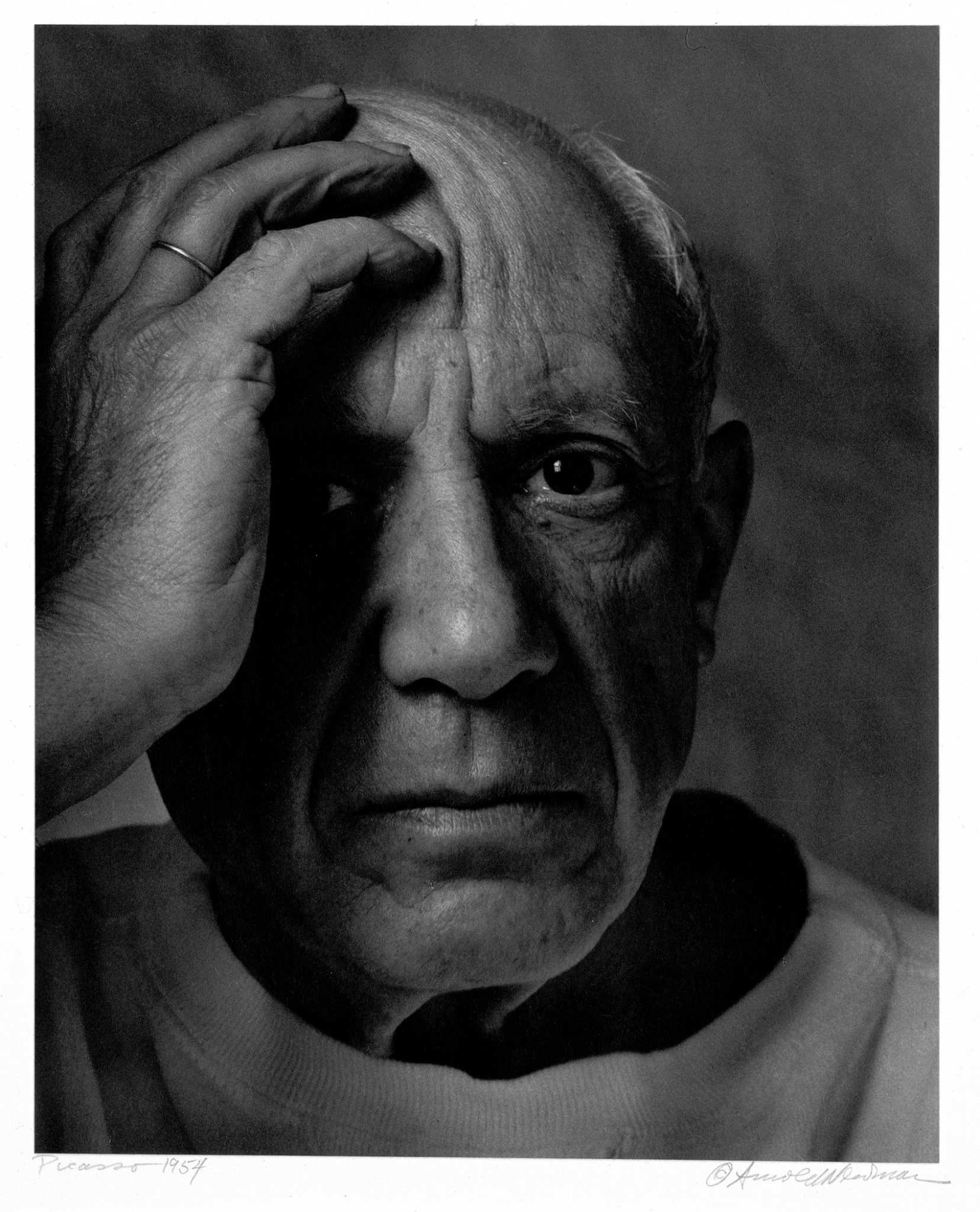
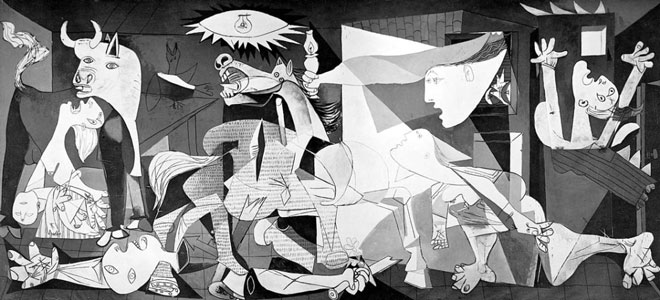
There are many reasons I have an immense love of Spain, not the least of which is its art. And while there is a veritable cornucopia of beautiful and meaningful paintings to indulge in throughout the country, there is little doubt that its most famous artwork is Pablo Picasso’s Guernica.

For those fortunate enough to visit Spain, you will wrestle with where to visit in your (presumably) short time there. That is completely understandable. However, if you miss out on visiting the Reina Sofia, where today Guernica is housed, then you should immediately consult a brain surgeon, as your corpus callosum has clearly been severed.

A Quaint View of Guernica

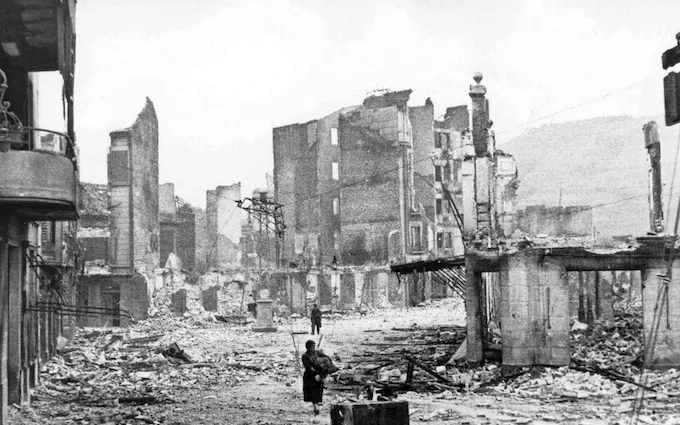
Although just a blip on the map with its population of around 16,000 people, the town of Guernica now holds the infamous distinction of being the victim of mankind’s first aerial carpet-bombing campaign in history on April 26, 1937. (While some assert that distinction lies with Barcelona in 1938, evidence seems to support Guernica being the first civilian population bombed in this new and horrific style from the sky.)

On that day, after Hitler had responded to Franco’s request to send some aerial firepower to Spain in a bid to help him bring an end to the Spanish Civil War, Hermann Göring’s Luftwaffe led the charge, attacking the spiritual capital of the Basque people by dropping 100,000 pounds (45,000 kg) of bombs on the tiny town over a period of three hours.

The Aftermath of the Bombing of Guernica

The result was devastating. Picasso, who at the time was living in Paris and working on a painting for the Spanish Pavillion at the upcoming Paris International Exhibition, heard about the bombing of Guernica shortly after it happened and was horrified. He immediately did away with what he was working on and began creating what was to become his most celebrated artwork. In fact, Picasso is said to have worked frantically on the painting for 35 days, finishing it on June 4, 1937.

Guernica

Guernica is now housed in the Reina Sofia, which, along with the Prado and the Thyssen-Bornemisza, makes up one-third of Madrid’s Golden Triangle of Art — one of the most illustrious pieces of art real estate in the world. And at 3.49 meters (11 ft. 5 in) in height and 7.76 meters (25 ft 6 in) in width, it is nothing if not daunting to absorb visually when you see it for yourself in person.

There are endless tales associated with this painting, from the work Picasso put into it nearly a century ago, to its role as a political tool/bargaining chip in the years it hung in New York’s Museum of Modern Art (MoMA), to its safe return to Spain in 1981. There are of course many books written about Guernica as well, one of which I read and enjoyed thoroughly was Gijs van Hensbergen’s Guernica: The Biography of a Twentieth-Century Icon.

Today, when thinking about Guernica and its long-lasting effect on the world as a whole, I go back to March 1945. As World War II was drawing to a close, Picasso said something to the French journalist Simone Téry in an interview which could very well be the perfect description of his most iconic work: “No, painting is not made to decorate apartments. It’s an offensive and defensive weapon against the enemy.”

1 Comment

Filed under Uncategorized

Home Sapiens/Human Beings

My Brother's Love Made Me Feel Blessed, No Matter What - Juvenile Justice  Information ExchangeJuvenile Justice Information Exchange

I find it interesting how books come into our lives, and the effect they have on us (or don’t have on us). I recently finished two books. One was a non-fiction title I received from a friend as a Christmas gift; the other was a novel chosen by a woman from my book club last month. The former was Yuval Harari’s Sapiens: A Brief History of Humankind, while the latter was Matt Haig’s The Humans.

I found that funny. Not funny like COVID-19, China picking on Lithuania (and removing the country’s name from its customs forms), Russia blaming the world for setting up shop on Ukraine’s border, or NHL stars not going to the Olympics. No. I found it funny that I had chosen neither book and yet both ended up being about, well, people like me — Homo sapiens/human beings

Both books opened my eyes, if in different ways. For example, Mr. Harari did an excellent job of documenting what we know about how Homo sapiens helped extinguish the other members of the genus Homo, almost like we were snuffing out a candle, leaving only us sapiens to work on wiping out the remaining 8.7 million species (est.) we share the Earth will. As Yuval Harari opined, it was almost like we were bent on exterminating life from our very inception.

For his part, Matt Haig, when not opening up the proverbial can of Riemann’s hypothesis, does a solid job of confirming that extra-terrestrial life not only exists, but that they also want ultimate control over the entire universe and will kill indiscriminately to maintain the present order of all things organic, even if that means no such things as love and passion and death and tragedy.

For me there were several times I paused and thought about what the authors were saying about me/us as a species. In The Humans, it was this:

“In every life there is a moment. A crisis. One that says: what I believe is wrong. It happens to everyone, the only difference is how that knowledge changes them. In most cases, it is simply a case of burying that knowledge and pretending it isn’t there. That is how humans grow old. That is ultimately what creases their faces and curves their backs and shrinks their mouths and ambitions. The weight of that denial. The stress of it. This is not unique to humans. The single biggest act of bravery or madness anyone can do is the act of change.”

In Sapiens, it was this:

“Seventy thousand years ago, Homo sapiens was still an insignificant animal minding its own business in a corner of Africa. In the following millennia it transformed itself into the master of the entire planet and the terror of the ecosystem. Today it stands on the verge of becoming a god, poised to acquire not only eternal youth, but also the divine abilities of creation and destruction…Self-made gods with only the laws of physics to keep us company, we are accountable to no one. We are consequently wreaking havoc on our fellow animals and on the surrounding ecosystem, seeking little more than our own comfort and amusement, yet never finding satisfaction. Is there anything more dangerous than dissatisfied and irresponsible gods who don’t know what they want?”

While I would not recommend The Humans unless you’re a fan of Robert Fulghum (and if you are, then you might just love this work of fiction), I think Sapiens should be mandatory reading for all literate Homo sapiens. It’s that good. More importantly, it’s that important.

1 Comment

Filed under Uncategorized

Inspiration

For an old friend…

“There are years that ask questions and years that answer.”
― Zora Neale Hurston, Their Eyes Were Watching God

100 Haunting eyes ideas | beautiful eyes, beautiful face, beauty
Greek Sculpture Wallpapers - Top Free Greek Sculpture Backgrounds -  WallpaperAccess
350+ Hope Pictures | Download Free Images on Unsplash
How Hope Motivates Your Team to Make Real Change, According to a  Psychologist | Inc.com

3 Comments

Filed under Uncategorized

Where Did Two Years Go?

“So, your Holiness, now your priests are dead, and I am left alive. But in truth it is I who am dead, and they who live. For as always, your Holiness, the spirit of the dead will survive in the memory of the living.”

The Persistence of Memory - Wikipedia
The Persistence of Memory

It’s been two years since I last posted. A lot has happened in the world over that time, but you already know that. You’ve lived it. You’re living it. You will continue living it until you realize this will always be with us, if only as a memory.

There are some who believe that every generation has a “moment” they live through that defines them, that defines us as a world. And while there were events such as WWI, the Great Depression, and WWII that affected most nations and peoples simultaneously, they were not as indiscriminate as the current epoch we’re still groping our way through as blind as bats. I, for one, would like to know who our one-eyed man is today.

To be fair, we’re still knee-deep in this shitstorm. I can’t reconcile where I’ve been over these two years or what the hell has happened. I’ve stopped writing; this is my first non-work-related writing since the proverbial candles went out in Toronto that fateful day in March. I haven’t seen my book club in person for more than 100 weeks. I’ve lost more than 30 pounds. I’ve spent solid time in two hospitals, seen a lot of wasted bodies, and been witness to cruelty I’ve not seen or heard previously.

4 Effective Ways to Put Out a Candle Without Smoke - wigglywisdom.com
The Guns of August

And yet…I’ve also seen the best of humanity firsthand in our nurses, doctors, and countless other medical professionals and hospital staff. In my family members and friends. In random acts of kindness. In small, meaningful gestures that have not gone unnoticed. I have a new appreciation for art. I cherish the dark of morning and the solace which music brings with it. Texting or chatting online is no longer a lame substitute for calling or seeing someone in the flesh. Two years into this sociological mindfuck I’ll take what I can get when it comes to human “contact.”

Teaching Our Children the Value of Hope - You are Mom
Hope

Nonetheless, despite all the negativity we have been inundated with for hundreds upon hundreds of days, I still have hope. I have not given up. Or as someone so wisely once said, “The light shines in the darkness, and the darkness has not overcome it.” Never before have I had such hope that the Leafs could actually win the Stanley Cup. That Team Canada will qualify for the World Cup of Rugby next summer in France. That everyone I love will make it through this hiccup in time with a few nicks and bruises, but otherwise stronger for the experience.

As Wally Lamb once wrote, “I know this much is true.”

6 Comments

Filed under Uncategorized

South Korean Art to Lift the Soul

In the face of a crisis, this is what lifts humanity. Enjoy…


Leave a comment

Filed under Uncategorized

International Women’s Day 2019

Image result for international women's day 2019

March 8, 2019 marks the 108th anniversary of International Women’s Day (IWD). Per the official IWD site:

The first International Women’s Day occurred in 1911, supported by over one million people. Today, IWD belongs to all groups collectively everywhere. IWD is not country, group or organization specific.

The future is exciting. Let’s build a gender-balanced world.

Everyone has a part to play – all the time, everywhere.

From grassroots activism to worldwide action, we are entering an exciting period of history where the world expects balance. We notice its absence and celebrate its presence.

Balance drives a better working world. Let’s all help create a #BalanceforBetter.

I’d like to take this opportunity to pay homage to the most influential woman I know, a civic advocacy leader, affordable housing champion, unrivaled proponent of older women’s rights through the Older Women’s Network, and (duh!) best mother in the world: my mom.

She was also the reason I had my first library as a young punk, and taught me that reading was not just cool; it was necessary, like food and water. For that, and so many other reasons, I hope that a day like IWD can inspire us all to push for greater changes in gender equality rights, and to reach out to the women in our lives who have impacted us in such meaningful, positive, and long-lasting ways.

Leave a comment

Filed under Uncategorized

Advice à la Stylo

Image result for william faulkner

(Hmm…cagey misdirection or evangelistic confidence?

Maybe a good ol’ pipe is all I need)

Emily Temple has an interesting piece in Literary Hub called “20 Pieces of Writing Advice from William Faulkner: “Don’t be ‘a writer’ but instead be writing.

What I love about this is that it can be applied (mostly) to everyday life and the challenges we face as partners, parents, employees…human beings. Here’s a snapshot of some of Mr. Faulkner’s choice thoughts:

On how to approach writing:

Keep it amateur. You’re not writing for money but for pleasure. It should be fun. And it should be exciting.

On technique:

Teach yourself by your own mistakes; people learn only by error.

On what makes a good novelist

He is completely amoral in that he will rob, borrow, beg, or steal from anybody and everybody to get the work done. . . . Everything goes by the board: honor, pride, decency, security, happiness, all, to get the book written.

On character:

The real truths come from human hearts.

On style:

I think anyone that spends too much of his time about his style, developing a style, or following a style, probably hasn’t got much to say and knows it and is afraid of it, and so he writes a style, a marvelous trove.

On writing towards the truth:

Our tragedy today is a general and universal physical fear so long sustained by now that we can even bear it. There are no longer problems of the spirit. There is only the question: When will I be blown up? Because of this, the young man or woman writing today has forgotten the problems of the human heart in conflict with itself which alone can make good writing because only that is worth writing about, worth the agony and the sweat.

On failure:

All of us failed to match our dream of perfection. So I rate us on the basis of our splendid failure to do the impossible.

On what a writer needs:

[T]he only environment the artist needs is whatever peace, whatever solitude, and whatever pleasure he can get at not too high a cost.

On the writer’s essential toolkit:

A writer needs three things, experience, observation, and imagination—any two of which, at times any one of which—can supply the lack of the others.

On the best training for writing:

Read, read, read. Read everything—trash, classics, good and bad; see how they do it.

And maybe the best piece of advice of all.

On also getting a job:

Don’t make writing your work. Get another job so you’ll have money to buy the things you want in life. It doesn’t matter what you do as long as you don’t count on money and a deadline for your writing.

Leave a comment

Filed under Uncategorized