Tag Archives: The Master and Margarita

Cloud Atlas at 20

If you read enough books, you’re bound to come across at least one author who touches your spirit in ways that rustle (or rock) your Tree of Life in a forever-poignant manner. If you’re lucky, said author will still be amongst the living. And if you’ve got destiny smiling down upon you, fate will intervene and you’ll get to meet that same author in the flesh. Such was my good fortune almost 20 years ago, when I spent a little time with the novelist David Mitchell in his adopted homeland of Ireland.

For me, it all started with the opening line of his first novel: “Who was blowing on the nape of my neck?” This was before David had achieved worldwide literary fame through Cloud Atlas (2004) and he was just finishing up his time teaching in Japan. By chance — pure, unadulterated chance — I came across a book called Ghostwritten (1999) while surfing this relatively new invention called the internet. This was also before the advent of social media, when the internet was still spelled with a capital “I,” cell phones had a neat new feature called “texting,” and email addresses were still dominated by the likes of Yahoo and Hotmail.

I mailed a handwritten letter to David’s publishing house after finishing Ghostwritten (for the first of three times) and asked if they would be kind enough to forward it to David himself. Some months later, I discovered, they had not only forwarded my letter to him, but he had replied to me — with a handwritten letter of his own. And thus our correspondence began.

To have watched his literary evolution this past quarter-century has been both mind-blowing and heart-warming: mind-blowing because you (and by “you,” I mean me) realize he’s this real-life towering figure of literature you’ve witnessed morph into a master wordsmith and purveyor of ever-more intricate plots and narrative structures over the years; heart-warming because you (again, me) know first-hand that he is not only an author who has seismically altered the bedrock of your life but also a man who is perhaps the best any of us could aspire to be: humane, empathetic, and deeply thoughtful.

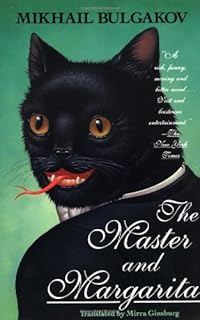
This is all my prelude to marking the 20th anniversary of the publication of Cloud Atlas, one of those books that, like The Wind-Up Bird Chronicle and The Master and Margarita, turns your world on its head.

Gabrielle Zevin, of recent mega-fame from her latest novel, Tomorrow, and Tomorrow, and Tomorrow, penned a lovely homage to Cloud Atlas not long ago in The Guardian titled “Cloud Atlas at 20: What makes a novel tattoo-worthy?” If you haven’t read the book yet, Zevin gives a quick overview, but mostly it’s about recalling why for her — and so many of us — this book is so special. One part she wrote, in particular, jumped out at me when I was reading the article:

It is because Mitchell is the kind of writer we want to be, and Cloud Atlas is the kind of book we want to write. It represents the possibilities for fiction – that there are new stories and new ways to tell them, that there will be readers for these new stories if only we can manage to be as brilliant as Mitchell.

When I flew out to Ireland all those years ago, I know now that I felt very much like that at the time. I suppose my real fortune was in learning not that David Mitchell was in fact a real person, but in discovering that he is just as brilliant and engaging as his indefatigably creative works of fiction. For those of us who find comfort in the hallowed pages of literature, that was nothing less than life-affirming.
Leave a comment

Filed under Uncategorized

Quote of the Day

Related image

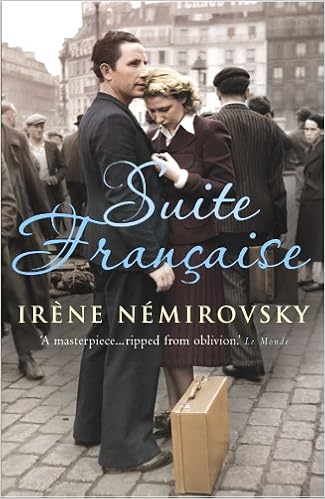
“But what is certain is that in five, ten or twenty years, this problem unique to our time, according to him, will no longer exist, it will be replaced by others…Yet this music, the sound of this rain on the windows, the great mournful creaking of the cedar tree in the garden outside, this moment, so tender, so strange in the middle of war, this will never change, not this, this is forever.”

Irène NémirovskySuite française

“The French Suite” is a special book for a few reasons. To begin, Irène Némirovsky wrote a beautiful story set in France during the Second World War. Second, her prose is eloquent, as can be evidenced from the above QOTD. Third, we’ll never know the “real” ending, as Némirovsky only completed two of the five stories planned for this novel before she was rounded up by the Nazis and sent to Auschwitz, where she was murdered. Fourth, by some miracle of you know who, “The notebook containing the two novels was preserved by her daughters but not examined until 1998. They were published in a single volume entitled Suite française in 2004.

I wrote about another brilliant work that survived a totalitarian regime through samizdat, The Master and Margarita, but there’s yet another book I read that somehow squeaked out from under intolerant noses, Life and Fate by Vasily Grossman. Per the Wiki entry on the book:

Life and Fate, the sequel to For a Just Cause, was written in the aftermath of Stalin’s death. Grossman submitted it around October 1960 for potential publication to the Znamya magazine. At this point, the KGB raided his apartment. The manuscripts, carbon copies and notebooks, as well as the typists’ copies and even the typewriter ribbons were seized.

In 1974, a friend and a prominent poet Semyon Lipkin got one of the surviving copies put onto microfilm and smuggled it out of the country with the help of satirical writer Vladimir Voinovich and nuclear scientist Andrei Sakharov. Grossman died in 1964, never having seen his book published, which did not happen in the West until 1980.

It would seem that in these cases there is much truth to the idiom The pen is mightier than the sword.

Leave a comment

Filed under Uncategorized

Samizdat: The Forbidden Fruit of Publishing

Image result for picking an apple, soviet union

Sweet ride! How ’bout ‘dem apples?

Scrabble players, here’s your word of the day: samizdat (no need for italics because it’s in English dictionaries!).

Essentially, a samizdat (a Russian word) refers to self-publishing, but in an environment when dissidents must go underground to avoid censorship or worse. According to the well-known Soviet dissident leader Vladimir Bukovsky, samizdat can be defined in the following way: “I write it myself, edit it myself, censor it myself, publish it myself, distribute it myself, and spend jail time for it myself.”

Nice!

Probably the most famous book published in this style was Mikhail Bulgakov’s The Master and Margarita, still one of my favourite novels of all time. And if you think it’s hard to get published today, read up on Bulgakov’s own tragic tale.

3 Comments

Filed under Uncategorized

The Master and Margarita: The Movie

Image result for the master and margarita

The Master and Margarita may soon be coming to a theatre near you. This is exciting news. Not only is Bulgakov’s magnum opus one of the finest pieces of literature/satire from the 20th century, but it’s one of my all-time favourite novels. The former point is relevant; the latter is obviously really, really relevant.

Apparently, Svetlana Migunova-Dali and Grace Loh have optioned the rights to produce Mikhail Bulgakov’s classic 1966 novel about the devil (who doubles as a “professor” and a “magician”) in Stalin’s Soviet Union, a talking cat, Pontius Pilate and Jesus.

Actually, it’s a miracle we have this book with us today. Bulgakov started the novel in 1928, burned the first draft in 1930, and by the time he finished a complete draft in 1936, he knew the government would become the same devil in his own work if he tried to publish it. Then, in 1940, so very near the end of a final version, Bulgakov died. Like Vasily Grossman’s Life and Fate, which also has an epic story behind how the manuscript survived and was ultimately published, it would take decades for The Master and Margarita to reach an outside readership.

This truly is the most uplifting news out of the literary-film world in a long, long time. Is it just me, or do theatres here in North America seem to be dominated by one of three types of movies these days: (1) Sci-Fi/Space/Fantasy (2) Animation (3) Cheesy adaptations of fondue-laden books that are vapid in substance and put the “less” in plotless? (Think of anything from the Twilight series to 50 Shades of Yada Yada Yada.)

In relation to this grrrreat! news about Bulgakov’s baby, Emily Temple (@knownemily) has written a thought-provoking piece for Literary Hub (@lithub) called “Who Should Star in the New Movie Version of The Master and Margarita? It’s Not Easy to Find a Charasmatic Giant Talking Cat.” In Ms. Temple’s post, she has cast a wide net on notable actors, including Adrien Brody, Sacha Baron Cohen, Janelle Monae, Mark Strong and Tom Hardy.

For all our sakes, let’s hope this optioning of the film rights doesn’t end up on the cutting room floor and that we can look forward to a movie version that does justice  to this timeless novel.

Leave a comment

Filed under Uncategorized