Kafka Makes His Canadian Court Debut

Image result for kafkaesque

It really is the small things in life that bring me a tremendous amount of pleasure. One of these things is when anything literary or linguistic makes its way into a court of law, which it did recently in New Brunswick, that scandalous little province always punching above its weight class.

In an article titled “Just what does ‘Kafkaesque’ mean? A New Brunswick judge weighs in,” Canadian Press journalist Rob Roberts reported from Fredericton about Paul Lynch, a local lab janitor, who was nailed for his 7th DUI-related offense in 2015. According to Roberts, “Because of his prior convictions, he [Lynch] was immediately remanded pending sentencing, and later sentenced to six months in jail.”

Here’s the problem: Nobody came to his hearing and he was never able to make a phone call, so when he didn’t show up for work the next day – or the 180 days after that – his employer fired him.

Seem logical and by the book? Well, not if you have a cursory understanding of Franz Kafka. Per the article, “In a new ruling, Justice Hugh McLellan defines Kafkaesque as the struggle ‘against rules and forces that cannot be understood.'”

What the Franz?

“Labour adjudicator John McEvoy ordered the health authority to give him his job back, in a decision that declared ‘no one . . . should face the Kafka-like situation faced by Lynch in respect of his inability to contact his employer.'”

While a little more out there than the “Oxford commagate” debacle in a Maine court case earlier this year, it’s interesting to note that Justice McLellan even invokes the legendary Prague, Bohemia, Austro-Hungarian (now Czech Republic) writer’s name in the first place, as notable publications like The New York Times and The Atlantic have published pieces in the recent past asking whether “Kakaesque” is “‘a word so overused it has lost all meaning?'”

Perhaps that’s why younger readers now say Murakamiesque? Should you need any clarification of what this adjective means, definitely pick up The Elephant Vanishes, though A Wild Sheep Chase and The Wind-up Bird Chronicle would suffice as well.

Literature aside, how can a Canadian citizen be arrested, convicted and then essentially forgotten about – and all without a single phone call?

I suppose you could ask The Globe and Mail (“Here’s how to fix a broken system“),  The National Post (“No faith in our justice system“), The Huff Post (“Canada Doesn’t Need To Fix Its Justice System. It Needs a New One“), or The Georgia Straight (“The Canadian justice system is so broken it’s criminal“).

Then again, if you wanted a slightly more objective POV, you could refer to last year’s report from the Macdonald-Laurier Institute, which graded provinces and territories in five categories: public safety, victims support, efficiency, fairness and access to justice, and costs and resources. Benjamin Perrin, a UBC professor of law, was one of the report’s authors.

How did Canada’s most populous province fair in the report card assessment? We suck, bottom third of the provinces, and an overall rating of a C+. Why, you ask? According to one CBC report by Alison Crawford, “Perrin points to how police can directly lay charges in Ontario.” That’s right. They don’t need the OK from the Crown beforehand (like in Quebec), nor do they even need the consent of an alleged victim.

As a result, says Mr. Perrin, “[T]here’s an awful lot of people being dragged through the Ontario criminal justice system who are ultimately having their charges stayed, withdrawn or acquitted. That is costing millions of dollars to the province but it’s also plugging up the system so that really important cases don’t make it through..”

That fact is scary enough, but what’s even more frightening is that Canada ranked 12th among 113 countries surveyed in 2016, according to the World Justice Project Rule of Law Index, “the world’s leading source for original, independent data on the rule of law.”

So, Mr. Lynch, if you think you had a Kafka-/Murakamiesque experience going through the justice system here in Canada, imagine what it would have been like in bottom-of-the-heap No. 113, Venezuela, 18 spots below Sierra-freaking-Leone and two spots down from Af-oh-my-ghanistan.

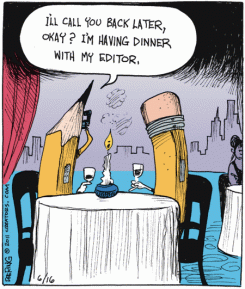
Leave a comment

Filed under Uncategorized

OAC Indigenous Culture Funds

Image result for OAC Indigenous Culture Funds

For residents of Ontario, the Ontario Arts Council’s (@ONArtsCouncil) Indigenous Culture Funds (ICF) programs are officially open for business. The ICF programs for individuals and organizations have been established to support First Nations, Inuit and Métis communities, culture and way of life.

Applications are now available for all three funding programs under the ICF:

ICF Small Grants

  • What this program supports: Short-term community, culture and way-of-life projects in Ontario with grants of up to $5,000.
  • Who can apply: Ontario-based Indigenous organizations, groups and individuals. First-time applicants, youth and Elders are all encouraged to apply.
  • Deadline: Applications accepted year-round.
  • Full details on this program.

ICF Project Grants for Individuals, Groups and Collectives

  • What this program supports: Larger community, culture and way-of-life projects in Ontario, with up to $30,000 for short-term projects and up to $60,000 for long-term projects.
  • Who can apply: Ontario-based Indigenous organizations, groups and individuals.
  • Deadline: November 1, 2017 at 1 p.m.
  • Full details on this program.

ICF Project Grants for Organizations

  • What this program supports: Large-scale projects undertaken by Indigenous organizations in Ontario, with up to $60,000 for short-term projects and up to $120,000 for long-term projects.
  • Who can apply: Ontario-based Indigenous organizations – including not-for profits, schools, service organizations, community centres, councils and more.
  • Deadline: November 1, 2017 at 1 p.m.
  • Full details on this program.

Leave a comment

Filed under Uncategorized

Rock Stars of the Publishing World

Image result for editor and author

Now, granted, I’m a little bit biased here, but let me draw you a picture. In your head. Can you see it yet? Let me try harder.

Remember when Dave Winfield was drafted by teams in the NBA, NFL, ABA (American Basketball Association) and Major League Baseball (as a freaking pitcher!) – and all in the same year! Okay, that guy had sick skills to pay the bills.

Then there was renegade Bo Jackson, an all-star in both Major League Baseball and the NFL. (Anyone remember the “Bo Knows” ads back in the early ’90s?)

Possibly the best-known and glitziest cross-sport athlete, however, is “Neon” Deion Sanders, who, in 1992, became the only athlete ever to hit a home run in the Majors and score a touchdown in the NFL in the same week. Booya!

Anyway, forget all that jazz. In the literary world, many will tell you that you’re either an editor or a writer. You can’t be both, and certainly not at the same time like the above-mentioned freaks of athletic nature.

Well, kudos to Literary Hub (@lithub) for putting us word nerds in our place and singling out some titans of literature that have indeed been cross-publishing all-stars, switch hitters, if you will, who played for both teams at one time in their careers.

In a piece titled “7 Writers Who Were Also Editors (And the Books They Edited),” LitHub associate editor Emily Temple (@knownemily) put together a list to make your head spin. Talk about a group of people who wear a cornucopia of hats!

Aside from their individual success as writers, you’ve got to take a look at the complete list of authors these people have edited in the past and ask yourself how they could have pulled this off.

On a personal note, my favourite person on this list (again, slightly biased) is David Ebershoff, a man who 1) is not only a brilliant novelist; 2) not only a remarkably gifted editor in fiction but non-fiction as well; 3) not only edited some of David Mitchell’s best work (Cloud Atlas, Thousand Autumns…WTF?); but 4) is arguably as intelligent and gracious as Mitchell himself, making the two of them – to use the above analogy – kind of like having Sidney Crosby and Connor McDavid on the same hockey team (2018 Pyeongchang Olympics, anybody?).

Leave a comment

Filed under Uncategorized

Quote of the Day

Image result for all of david sedaris books

Anyone who doesn’t like David Sedaris should investigate whether they have a malignant tumour eating away at the fabric of their entire brain. Not that I have a strong opinion on this subject, but he’s genuinely one of the funniest people I know writing in the English language. If standup comics need that certain je ne sais quoi to deliver a punchline, then writers of humour need a certain ability with the language to mold it, shape it, massage it, and then deliver it on the page in just such a way that you can’t help but laugh and think, Who writes shit like this?

David Sedaris does. And, on a day when I felt a needed a good laugh, I went in search of some classics from some of Mr. Sedaris’s classics. These are obviously just a few handpicked from a seemingly limitless black hole of funnies. But funny, they are, and hopefully they will make you laugh and lighten your day a little.

“He took a sip of my father’s weak coffee and spit it back into the mug. “This shit’s like making love in a canoe.”
“Excuse me?”
“It’s fucking near water.”

Dress Your Family in Corduroy and Denim

“For the first twenty years of my life, I rocked myself to sleep. It was a harmless enough hobby, but eventually, I had to give it up. Throughout the next twenty-two years I lay still and discovered that after a few minutes I could drop off with no problem. Follow seven beers with a couple of scotches and a thimble of good marijuana, and it’s funny how sleep just sort of comes on its own. Often I never even made it to the bed. I’d squat down to pet the cat and wake up on the floor eight hours later, having lost a perfectly good excuse to change my clothes. I’m now told that this is not called “going to sleep” but rather “passing out,” a phrase that carries a distinct hint of judgment.”

Me Talk Pretty One Day

“If you’re looking for sympathy you’ll find it between shit and syphilis in the dictionary.”

Barrel Fever: Stories and Essays

“When asked “What do we need to learn this for?” any high-school teacher can confidently answer that, regardless of the subject, the knowledge will come in handy once the student hits middle age and starts working crossword puzzles in order to stave off the terrible loneliness.”
Me Talk Pretty One Day   

“I wanted to deny him, but that’s the terrible power of a diary: it not only calls forth the person you used to be but rubs your nose in him, reminding you that not all change is evolutionary. More often than not, you didn’t learn from your mistakes. You didn’t get wiser, but simply older, growing from the twenty-five-year-old who got stoned and accidentally peed on his friend Katherine’s kitten to the thirty-five-year-old who got drunk and peed in the sandbox at his old elementary school. “The sandbox!” my sister Amy said at the time. “Don’t you realize that children have to pee in there?”

Let’s Explore Diabetes with Owls

“This left me alone to solve the coffee problem – a sort of catch-22, as in order to think straight I need caffeine, and in order to make that happen I need to think straight.”

When You Are Engulfed in Flames

“The way I saw it, if my students were willing to pretend I was a teacher, the least I could do was return the favor and pretend that they were writers.”

Me Talk Pretty One Day   

Leave a comment

Filed under Uncategorized

Freelancers! Copywriting! Unemployed Bums from the Slums!

Image result for confusing copywriting

Ha ha ha ha haaaaaaaaaaaaaa….ha….haaa.h.a……….sniff, sniff…sniff sniff sniff…

I laughed so hard when I pulled up this image. A friend of mine (one of my BFF bestest friends, actually!) sent it to me by email with the subject line “Harris, you suck big, long,  sharp-ass rhino horns.” (He’s always doing cute things like that with the English language.)

Anyway, I was almost crying when it suddenly dawned on me: Wait! I’m a freelancer. Then the waterworks really went on full blast and people around me thought it was rainin’!

Moving right along, a couple of days ago, Jason Fox penned something that many corporate freelance writers will be able to relate to called “When Copy Loves Itself Too Much: I’m not a narcissist but sometimes my copy is.”

Mr. Fox backs up this title with the following explanation: “Narcissism in writing, as I see it, is when preference is given to a strategy, technique, or style that aligns with personal preference rather than what actually works with a given audience.”

I’ve done copy for magazines and brochures many times, and while Mr. Fox presents a very convincing argument about the technicalities of bad copy in English, I’d like to share some of my favourite copy from Korean companies. Your challenge, if you so accept it, is to read the following taglines and see if you can guess the product/company in question.

Ready? Set? Let’s go…………..

1) Big Plus!

2) Be Alive!

3) Change the Life

4) Have a Good Time

5) Ice Cream & City

6) You Can Do

7) Bravo Your Life!

And the absolute “piece of resistance” from back in my day in Korea:

8) Even Hitler Couldn’t Have the East and the West

Answers:

1) LG (credit card…better than a minus!)

2) Minute Maid (fruit juice…as opposed to dead?)

3) Daehan (life insurance…I’ve always wanted to be someone else.)

4) KTF (telecom/cell phone services…Thank you! I will have a good time…with another service provider.)

5) Baskin Robbins (ice cream…so if you don’t live in an urban centre…)

6) Pagoda (cram school/private language education…too many possibilities here, but it’s perfect that it’s a language school that f***ed up the grammar of their slogan)

7) Samsung (opera insurance…Ha ha ha. Just kidding. It’s life insurance. Obviously.)

8) Coreana (mung bean skin care product…Just watch the TV ad yourself by clicking on this link.)

Finally, to see some funny – and twisted – slogans that got seriously lost in translation, check out this slideshow from Business Insider.

Leave a comment

Filed under Uncategorized

Writing Out Numbers Properly

Image result for fibonacci numbers

Okay, okay, okay. This post makes me a word, er, number nerd. Officially. Like I needed public validation of that one!

Whatevs.

Even if you aren’t a professional writer, but would like to come across as something more than moderately educated when you write for professional purposes, this Public Works and Government Services Canada website is a great resource on how to  deal with numbers in written form.

Click on the link here to learn how to do it right.

P.S. Bonus points if you know what the above numbers represent.

P.P.S. Am I the only some-young-guy who loves it when people say “maths”?

Leave a comment

Filed under Uncategorized

Quote of the Day

Related image

(I selflessly volunteered for this photo shoot, but forgot to put on any clothes at the last minute. Much and many apologies – Ed.)

“Talent is cheaper than table salt. What separates the talented individual from the successful one is a lot of hard work.”

– Stephen King

I can’t think of anyone more deserving to make such a statement than Stephen King. Not only is he uber talented, but the guy works like a racehorse on ‘roids. Even after his near-fatal accident in which he was hit by a vehicle while walking along Maine State Route 5 in 1999 – and subsequently suffered through five surgeries in 10 days – King was back at it and typing away the same month he was discharged from the hospital (ironically enough, he was writing On Writing: A Memoir of the Craft at the time).

This particular quote stuck out to me this morning because, for the first time in a long time, I am back at the creative process. I’m writing a new book called The Lilacs of Spring – and it’s grueling. What those involved in the film and publishing industry understand only too well is that the amount of time spent on the “non-content process” (for lack of a better term), such as conceptualizing, planning, editing, designing, proofreading, promoting, advertising, etc., is much longer in terms of the number of hours you and a whole team put into the final product; the difference with the creative process is that it requires long bouts of intense, sometimes agonizing, concentration. Kind of like, I don’t know, pushing a massive boulder up a mountain in all your birthday suit glory. For writers, especially novelists, that often means early, early, early morning hours.

In my own case, I now wake up at 3 a.m. five days a week and 4 or 5 a.m. two days a week. The goal is to write 20 pages a day (which I believe is Mr. King’s daily aim as well), but I rarely accomplish that for one reason or another. Still, it’s important to have the goal in place, otherwise it’s easy to procrastinate, dilly-dally, and basically f*** the dog while the hours wither away and you have but a single paragraph done by the time the sun sets to show for all your “hard work.”

Anyway, if you haven’t read On Writing and you’re thinking about penning your own book, starting a literary career, or simply have a curiosity as to how the mind of an artistic genius like Stephen King ticks, do go and get that special little gem. You won’t be disappointed.

1 Comment

Filed under Uncategorized

ATTN: Jay Gatsby SUBJECT: $$$

Image result for rich person looking poor

I wonder what Jay Gatsby would have to say about this article in the NYT by Rachel Sherman (@rwsherman10) titled “What the Rich Won’t Tell You.”

Eye-opening though it may be for some, my own experiences with the super-rich here in Toronto have taught me that New Yorkers are not alone in this category of what I like to call “social stratification avoidance.” They drive cars like Subarus and Kias; their kids go to public schools; they take modest vacations within…gulp…Canada.

Alternatively, sandals are what you wear on your feet; first class is the opening lecture of a semester; the Hamptons were a jazz musician (Lionel) and a Confederate general (Wade); and The Great Gatsby is soooooo passé, a novel from a bygone era that is no longer relevant.

Funny to think how out of touch Donnie T. is there in his house painted white. How he must pine to return to the Palace of Versailles on 5th Avenue. Mon Dieu! Imagine if he were cultured enough to actually visit the real Versailles, study its storied past in French history, and understand why it is now a public venue for people to visit and learn from, not live in and show off with unconscionable pride.

Leave a comment

Filed under Uncategorized

What You Should Be Reading, Scientifically Speaking

Image result for myers-briggs type indicator

Where would be without the dependable and attractive Myers-Briggs Type Indicator (MBTI)? In an article from bustle.com called “The Genre Of Book You Need To Be Reading, Based On Your Myers-Briggs Type,” Charlotte Ahlin (@CharlotteAhlin) breaks down how this system works and, more specifically, how it relates to your ideal reading tendencies.

The MBTI is an introspective personality quiz based on Jungian psychology. According to R.M. Kaplan and D.P. Saccuzzo, co-authors of Psychological Testing: Principles, Applications, and Issues, “The underlying assumption of the MBTI is that we all have specific preferences in the way we construe our experiences, and these preferences underlie our interests, needs, values, and motivation.”

As Ms. Ahlin explains:

Myers-Briggs uses four different sliding scales to determine your fate: the “I” or “E” stands for “introvert” or “extrovert,” which is pretty self explanatory if you’ve been to the internet before. But there’s also “N” or “S” for “intuiting” or “sensing,” which describes whether you intuit information internally or observe it externally. Then there’s “T’ or “F” for “thinking” or “feeling,” which determines whether you’re naturally logical or naturally emotional. Finally, there’s “P” or “J” for “perceiving” or “judging,” which means you’re either a go with the flow improviser or a highly organized decision-maker. 

If nothing else, it’s fun to take this Myers-Briggs test. Why? Because tests are fun, funny and funnily. I myself took it and have determined that I am, first and foremost, an ENTP personality. That corresponds to thrillers, which I do enjoy very much. A close second for me is ENFJ, which corresponds to literary fiction, the genre I now write most of my books in professionally.

Click the above article link if you’d like to take the test and see which field of literature most closely matches your personality type.

1 Comment

Filed under Uncategorized