ATTN: Deaf Artists & Artists with a Disability

Image result for oac deaf and disabled arts projects

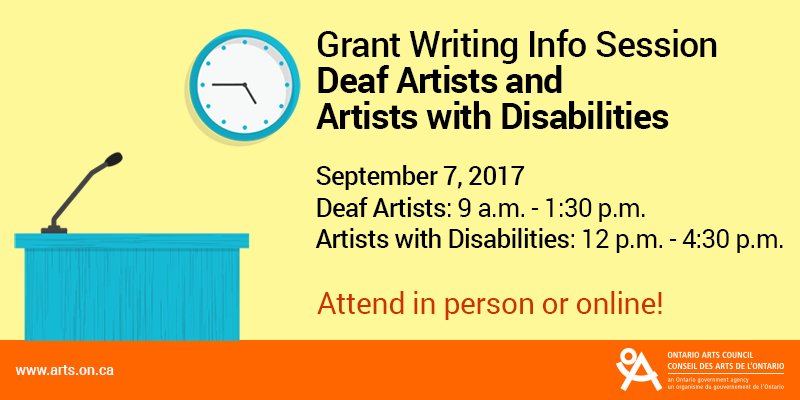
If you’re a deaf artist or an artist working with a disability AND you’re a resident of Ontario, check out this link for the Ontario Arts Council’s upcoming Grant Writing Info Session, which will take place on September 7. You can attend in person or online.

The deadline for the related arts project grants is October 5.

Leave a comment

Filed under Uncategorized

Quote of the Day

Image result for hunter s thompson

“We are all alone, born alone, die alone, and—in spite of True Romance magazines—we shall all someday look back on our lives and see that, in spite of our company, we were alone the whole way. I do not say lonely—at least, not all the time—but essentially, and finally, alone. This is what makes your self-respect so important, and I don’t see how you can respect yourself if you must look in the hearts and minds of others for your happiness.” 

Hunter S. Thompson, The Proud Highway: Saga of a Desperate Southern Gentleman, 1955-1967

I don’t now why (though I sorta/kinda do), but I woke up (i.e. raised my torso after a sleepless night) and had Hunter S. Thompson on my mind. If you’ve read War and Peace, the above quote might remind you of one of Tolstoy’s most famous passages from his opus (the “Love hinders death” passage).

My first foray into Hunter baby’s world came with Fear and Loathing in Las Vegas. To this day, it and Philip Roth’s The Great American Novel remain  the two funniest books I’ve ever read. With Thompson, the man had an ability to live in and describe the world he was a part of like nobody else. While some may brush off gonzo journalism as hack writing or immature, drug-addled creativity, I have personally never read anyone like him before or since.

Another quote that came to mind this morning as I ambled around my apartment in the wee morning hours like a decrepit old man with failing bones was from the same book as above:

“Life should not be a journey to the grave with the intention of arriving safely in a pretty and well preserved body, but rather to skid in broadside in a cloud of smoke, thoroughly used up, totally worn out, and loudly proclaiming “Wow! What a Ride!”

Finally, on a more positive note (I think), I’ll close off Hunter S. Thompson’s Quote of the Day with a simple line that has more value to it than you might think at first. In its quietly pessimistic yet sobering logic, there’s actually something positive to be taken from it:

“Life has become immeasurably better since I have been forced to stop taking it seriously.”

Leave a comment

Filed under Uncategorized

On Drinking and Dead Parents and Life on Other Planets

Image result for looking up at the stars

I’m not even going to bother summing up this moving piece by Amy Gesenhues (@amygesenhues). If the title piques your curiosity, then do not pass go or collect $200. Just click here to read this post by Ms. Gesenhues.

Leave a comment

Filed under Uncategorized

Quote of the Day

Image result for beautiful canyons

“Should you shield the canyons from the windstorms you would never see the true beauty of their carvings.”

                                                 Elisabeth Kübler-Ross 

There are times you read something and it just hits you in the gut with explosive force, perhaps because of the beauty of the prose, the fact that you relate to it so viscerally, or – like in cases such as this Quote of the Day – both at the same time.

Before today I wasn’t familiar with name Elisabeth Kübler-Ross, but now I realize how influential she was in her long and accomplished life.

Per Ms. Kübler-Ross’s bio on Goodreads:

Elisabeth Kübler-Ross, M.D. was a Swiss-born psychiatrist, a pioneer in Near-death studies and the author of the groundbreaking book On Death and Dying (1969), where she first discussed what is now known as the Kübler-Ross model. In this work she proposed the now famous Five Stages of Grief as a pattern of adjustment. These five stages of grief are denial, anger, bargaining, depression, and acceptance. In general, individuals experience most of these stages, though in no defined sequence, after being faced with the reality of their impending death. The five stages have since been adopted by many as applying to the survivors of a loved one’s death, as well.

Leave a comment

Filed under Uncategorized

Happiness Is in the Details (& Get the Hell Off Facebook)

Image result for happy and sad

Robert Cormack (@rbcormack) has certainly given me a lot to think about early this Monday morning through his piece entitled “Happiness Is Boring: The un-glamorized truth about our cheery, merry, joyful and beatific lives.”

He begins by referring to Shel Silverstein’s poem “The Land of Happy.”

Have you been to the land of happy,
Where everyone’s happy all day,
Where they joke and they sing
Of the happiest things,
And everything’s jolly and gay?
There’s no one unhappy in Happy
There’s laughter and smiles galore.
I have been to The Land of Happy-
What a bore

Mr. Cormack then continues his happiness odyssey by taking aim at Facebook. People post on FB, he claims, to make us envious of their travels and accomplishments and la-dee-da life. We scroll through posts looking for happiness or joy or some sort of ejaculation-like release of endorphins, oxytocin, serotonin, and dopamine. Sadly, studies show we only end up sadder after spending time on Facebook. And the longer we’re on it, the further down the rabbit hole of depression we fall. Counterproductive? You bet. Counterintuitive? Duh.

Mr. Cormack references a bunch of heavyweights throughout history, including an interesting story behind the etymology of the word “fleeting,” but there’s one particular line from his piece that I really liked:

Maybe that’s why some people never find joy. Like everything in our universe, it’s more or less a mistake. It’s like love. Love is crazy. Trying to figure it out is like trying to understand roughage. We just know it works.

I suppose the lesson here is that happiness is not the goal, it’s the journey. It’s not in the comparisons to other people’s lives or accomplishments but in the day-to-day struggle we all find ourselves in no matter how fantastic! our perfect situation may seem to others. The truth is that we’re all fighting our way through this jungle called existence, and the only people who enjoy a modicum of what can loosely be referred to as happiness are those who realize that “there” is no better than “here,” and that happiness is not the end goal. It’s in the here and now, the trenches of daily life, and the challenges we face on a minute-to-minute basis.

To quote a man far wiser than myself, I’ll refer to one L. Tolstoy, who once said, “If you want to be happy, be.”

Leave a comment

Filed under Uncategorized

Literary Job Openings

Image result for publishing jobs

Per the Quill & Quire job board, here are a few job openings that have gone up over the last week or so. Click on the links to learn more about each position.

1. Social Media Coordinator

Penguin Random House Canada

2. Sales Assistant

Penguin Random House Canada

3. Associate Editor

Annick Press

Leave a comment

Filed under Uncategorized

Grammar Test!

Image result for grammar test

Ooh ooh ooh! Who doesn’t love a good ol’ fashion grammar test? I mean, seriously. Right?

Globe and Mail Public Editor @SylviaStead and Focus section editor @VicDwyer jointly put together this little bundle of joy, which consists of 15 questions and explanations to go alongside each answer, with the aim of giving readers the chance to see if they’re a charter member of The Globe’s good-grammar fan club.

I know this is going to be hard to believe, but I actually scored 17 out of 15, so I guess that makes me the president of this club. If you score between 5 and 10 you’re supposed to be proud of yourself. Score above 10 and you’re an unofficial member of this good-grammar fan club.

So, without further ado, click here to take the test yourself.

Leave a comment

Filed under Uncategorized

Are You a Genuinely Good Person?

Image result for act of kindness

In her article titled “Are you a good person, or just insecure?”  attorney Lidija Hilje essentially asks whether the good things you do are done because they make you feel good, or instead beause you were taught to act that way/are fearful of the reprucusssions if you don’t do good/believe in a more theoretical way that good for good’s sake makes it right. The reason this is important, she argues, is that motivation lies behind whether the act (and therefore the person) is genuinely good.

For example, is the act of holding the door open for someone sufficieiently good in and of itself, or does it matter that you only do so for cute girls you’re interested in talking to?

By extension, is it possible to do good for the wrong reasons? Is spending time with your grandfather only in his twilight years a kind act on its own, or does it matter that you’re trying to wiggle your way into his will?

These are the types of questions Ms. Hilje examines in her piece and she basically comes up with three things to change our underlying motives. Here’s a short summary.

1. Detect

The hardest part with making a change is detecting what needs to be changed. Since we are subjective by nature, and since we pretty much appear super normal to ourselves, this part is a challenge. On the other hand, just by detecting notions that are harmful, more than half your job is done.

2. Deflect
When you’ve realised what you need to work on, or when you recognise in a certain situation that your motivation is off, make the effort to make the change in the right direction. This will sometimes mean saying no to some people you have usually said yes to; it might also mean standing up to people you never stood up to before. It is very trying, but well worth it.


3. Respect

Yourself.

Make a conscious choice to have higher regard for your personal boundaries. Respect yourself enough to give yourself a gift of personal freedom.

Leave a comment

Filed under Uncategorized

The Power of Invisible

Image result for shadow drawings

In a powerful piece for The New York Times, noted writer and essayist Roger Rosenblatt recently penned a piece titled “The Invisible Forces That Make Writing Work.” Although ostensibly about the non-visible forces that shape writing, the overarching theme is one that transcends the craft and whose lessons can be applied to our everyday lives.

That’s why, I suppose, Mr. Rosenblatt begins his piece for the Book Review section by quoting @kathrynschulz:

“[W]e cannot see most of the things that rule our lives. Magnetic fields, electric currents, the force of gravity all work unseen, as do our interior arbiters of thoughts, inclinations, passions, psyches, tastes, moods, morals, and — if one believes in them — souls. The invisible world governs the visible like a hidden nation-state.”

As Mr. Rosenblatt goes on to point out, good fiction mirrors life in that there are signs that pop up at every step of our lives; often it is only in hindsight that we as readers (and human beings) pick up on this and make sense of these clues. And just as nature is defined by change, so too is writing an organic process.

Roger Rosenblatt specifically refers to Fitzgerald’s The Great Gatsby, but I think many readers would be surprised how much even character names (let alone their relationships and personal growth arcs) change through the draft process. The same is also true of us as humans. We have an idea where we want to be in, say, a year, yet along the way there are so many competing forces at play that it’s inevitable we will end up somewhere else – and as someone else.

I think that’s part of the reason an author like Jonathan Franzen is so popular today. His stories aren’t particularly complex or radical in their approach. Still, Franzen manages to capture the complexities of personal growth and interpersonal relationships, especially in a book like Freedom.

Mr. Rosenblatt ends his own piece for the NYT by describing how he resurrects the invisible through his own writing, and it’s a poignant message:

“I am not unaware that my writing has improved in the nine years since our daughter’s death. My work is sharper now, and more careful. Happily would I trade all the books I’ve written in those nine years for one moment with Amy alive, but since that bargain is impossible, I write to fill the void her death created. And something else: Since I believe it was Amy’s death that led me to write more seriously, she lives with me invisible. I write to see her.”

Leave a comment

Filed under Uncategorized

Open Door Funding

Image result for Toronto, open door funding

“Funding opportunity designed to respond to timely and ambitious arts sector initiative.”

Do you have an arts initiative in Toronto worthy of funding? If so, then @TorontoArts may have some money for you. Click here to learn more.

Leave a comment

Filed under Uncategorized