Learning to Read & The Brain

Image result for cerebral cortex and thalamus

Anything to do with the brain, science and reading has me hooked from page one. Yesterday, Torah Kuchar (@DrTorahKachur) did exactly this when she reported through the CBC in a piece called “New research reveals what happens when adults learn to read.”

Obviously – OBVIOUSLY! – the cerebral cortex (learning and high intellectual processes) lights up like a Rockefeller Center Christmas tree when someone is learning to read, but it was scientists didn’t expect that intrigued them:

“The ability to read stimulated deeper, more ancient brain structures like the thalamus that normally functions as a relay point to integrate sensory and motor input and is involved in consciousness and sleep regulation. None of those functions you’d really associate with reading.

What they found was that the ability to read is not unique to humans in that other mammals can distinguish complex written shapes, and we share those brain regions. This doesn’t mean mice can read Tolstoy, but that they have similar brain structures to process complex symbols. What they can’t do, and what we can, is ascribe meaning to those shapes. We use our higher level processing centres in our cortex to do this.”  

Ms. Kuchar goes on to discuss how this impacts our understanding of dyslexia (any of various reading disorders associated with impairment of the ability to interpret spatial relationships or to integrate auditory and visual information) and in what way(s) the thalamus may have something to do with its origins.

I’d like to utter a witticism after reading an article like that, perhaps something along the lines of “I f****** love science,” but unfortunately someone already beat me to the punch (line) on that one.

Leave a comment

Filed under Uncategorized

TAC: Animating Historic Sites Grants

Image result for animating historic sites

Individual artists, organizations and collectives, this is your chance to apply for funding from the Toronto Arts Council (@TorontoArts) for its Animating Historic Sites initiative. The deadline is July 17, 2017 and may cover up to 100% of project costs. Click on the previous link to download full program guidelines and view past recipients.

Per the TAC website:

Toronto Arts Council has partnered with City of Toronto Museum Services and the Evergreen Brick Works to provide opportunities for artists to re-imagine and animate six Toronto Heritage sites and the Brick Works through engagement with their histories, local contexts, and communities.

TAC has two distinct funding envelopes: 1) Arts Discipline funding (e.g. discipline-specific project grants and operating grants) and 2) Strategic funding (e.g. Animating Historic Sites, Animating Toronto Parks, Artists in the Library, etc.). Applicants are eligible to receive only one grant from each funding envelope per calendar year. Applications to the Animating Historic Sites program fall within the Strategic Funding envelope. Any other Strategic Program grants must be complete with a final report filed and approved to meet eligibility criteria. (*Please note: Newcomer and Refugee Artist Mentorship grants do not fall under the category of Strategic funding).

Leave a comment

Filed under Uncategorized

Quote of the Day

Image result for 419
“[M]y fear is that when we die, we’ll have to watch all those moments in our lives when we were short-tempered with our children, all the times they needed our love and we didn’t give it, all those times we were distracted or in a bad mood, and all the times we were angry or impatient. My fear is that when the time comes, I’ll have to watch all those moments again. That they’ll make us watch them before we can get into Heaven.”

Will Ferguson, 419

I know what you’re thinking: Why would you name your novel after an area code? While that is a good and dandy catechism of the secular, non-political variety, the title is not in fact a way to call Toledo, Ohio, but refers to a section of the Nigerian Criminal Code that deals with fraud, as well as the charges and penalties for offenders of this crime.

I also know what you’re thinking right now: Nigeria? Why would that fine, upstanding country need Article 419 as part of its Criminal Code? I’ll let Will Ferguson answer that one through his Giller Prize-winning novel of the same name, err, number.

Before I move on, however, let me provide you with a classic 419 email.

Subject: USE FOR THE LESS PRIVILEGED From: “Mrs.Isabella Caromel” <isabecaromel1515@yahoo.com.my>

Good day
Private Message to you,

This is an important message to you.The lord directs me to share this with you. As you read the mail, you should sympathize with my current situation and assist me. My name is Isabella Carmel the only survivor from family of four. I was narrowly escaped from the tsunami disaster which affected my spinal cord and also my ear drum and claim the lifes of my entire family, husband (Denis caromel) and two sons (Ugo and Tom) who went for holidays in Sri-Lanka.

Right now I am currently in Kuala Lumpur Malaysia. After staying a week in my family hospital, I was disabled by the catastrophe and now on a wheel cheer after all the treatment.This has defiled all forms of medicine and right now I have only about a few months to live, according to medical experts.I have not lived my life so well as my primary interest and focus was only on my late fathers business. Though my father is very rich and was never generous. But now I regret all this, as I know that there is more in life than just wanting to have or make all the money in the world.The bible says what shall it profit a man to wine the whole world and loose his soul. I believe when God gives me a second chance to come to this world I will live my life a different way from how I have lived before. I have willed and given most of my fathers properties to the less privileges because I want God to be merciful to me and accept my soul. I have decided to give arms to charity organizations and give succor and comfort to the less privileged in our societies. I want this to be one of the last good deeds I do on earth since my father has never recognized that.

So far I have to distribute money to charity organizations now that my health has deteriorated so badly,I cannot do this myself anymore that is why am soliciting your assistant to make this donation through you. The last of my late fathers money that am willing to donate to the less privileged right now is the huge sum of $10.6M USD that is concealed in a consignment and deposited in (OVERSEA CREDIT COMMISSION ABROAD) for safekeeping which he intends to invest on profitable factory.

I want you to help me claim this funds where is deposited and disburse it to charity organizations and the less privileged in the society.Please I will appreciate you to indicate interest for the disbursement and also include your contact telephone/fax numbers that I will forward to the(OVERSEA CREDIT COMMISSION ABROAD) to be able to contact you as the appointed beneficiary. I will provide you the certificate of deposit and the letter of authority to enable you claim the consignment of the funds.

If you are willing and ready to assist with this project,please e-mail me at isabecaromel900@myway.com without delay, while I wait to hear from you.Thanks once again for your kindness may God guide and reward you in all your endeavors as you make me realize my last dreams and wishes.

Remain blessed,
Mrs.Isabella Caromel

Now that’s the $$$ shot! Good on ya, Mrs. Isabella. Heart goes out to you. For trues and for reals!

Anyway, 419 is a very good book and the above quote is quite poignant. However, if you want to listen to a podcast that takes it about 156 steps past what Mr. Ferguson did with his novel, check out NPR’s This American Life, Episode 363: Enforcers and click on Act One, “Hanging in Chad.” These guys take “revenge is a dish best served cold” to new heights.

Leave a comment

Filed under Uncategorized

Do Authors Actually Want Reviews?

Image result for reading a review, looking scared

I had to link to an article I recently read because it both brought a smile to my face and reminded me how terrifying it is the moment you hit PUBLISH (online) or SEND (to the publisher) and you realize your baby is now up for public consumption.

Raymond Esposito posted a piece on Writers After Dark (@WritersAfterDrk) titled “Why Authors Don’t Really Want Reviews,” and one passage in particular stuck out for me:

“There is a lot of ego in writing. It’s a very personal, very intimate product. And the truth is that every author who has ever hit that publish button truly believes their work is ready for public consumption. And every author desires the confirmation that it really was good.”

I’ve always contended that artists, as opposed to business people or scientists, for example, go through a much more personal journey when they bring their product to market. It’s not a lab study or a new tire for SUVs; it’s a piece of your soul, and to see people not embrace it wholeheartedly is kind of like stripping naked in public and having passersby gawk at you as they mutter, “That’s what you look like underneath your cheapass rayon sweat pants and mesh tank top? Man alive! Put your clothes back on. You’re making children cry and searing my retinas after just a glance in your general direction.”

To answer Mr. Esposito’s question, however, I think all writers want positive reviews that support said author’s belief that their work is unprecedentedly brilliant, as he points out, but writers need reviews if they’re to sell more than a few books.

I think the real problem today is something Jonathan Franzen pointed out in a 2013 interview with the BBC and the fact that writers today spend most of their time promoting their work and networking and trying to get others to review their stories than they do actually honing their craft:

“What I find particularly alarming, again, from the point of view I care about, American fiction, is that it’s a coercive development. Agents will now tell young writers: ‘I won’t even look at your manuscript if you don’t have followers on Twitter’. I see people who ought to be spending their time developing their craft and people who used to be able to make their living as freelance writers. I see them making nothing, and I see them feeling absolutely coerced into this constant self-promotion.”

Ugh.

Leave a comment

Filed under Uncategorized

‘Population Zero’ Toronto Film Premiere

Image result for population zero

My good, good friend, Sir Baron von Tyler Levine IV (@TylerLevine), produced a kick-ass crime/mystery/thriller called Population Zero, and it premieres May 26 at Carlton Cinema in downtown Toronto (Yonge and Carlton).

As per IMDB, here’s a summary of the plot:

In April 2009, three young men were killed in a remote part of Yellowstone National Park. Authorities Never Found the Murderer. He Found Them. Only hours after three young men were gunned down in cold blood, Dwayne Nelson walked into a ranger station miles away and confessed to the crime. Despite his detailed confession, Dwayne Nelson was allowed to go free because of a loophole in the American Constitution. Award Winning Canadian Documentarian Julian T. Pinder (Trouble in the Peace, Land, Jesus Town) travels to Yellowstone in a cinematic and compelling chase for truth behind a crime that should have rocked the nation. How did the United States Constitution, the supreme law of the United States of America, let a guilty man go free? In his hunt for answers Pinder breaks the first rule of documentary film making by allowing himself to become a subject in the story; risking his life and others when he finds evidence that could re-open the case of the Yellowstone Murders years later.

It’s a great film, but it’s only running for one week, from May 26 to June 1, so make sure you head down and check it out.

Tickets are $10 for adults ($5 all day on Tuesday, May 31), and here is a link to Carlton Cinema, where you can find showtimes and make a reservation online.

If you’re a real go-getter and like harassing good-looking people who are bound to be famous before long, there will be a Q&A after the 6:45 p.m. screening of Population Zero this Friday, May 26.

Leave a comment

Filed under Uncategorized

Warning: Reading in Bed Can Kill

Image result for bed on fire

Writing for The Atlantic, Nika Mavrody wrote an interesting piece on reading titled “The Dangers of Reading in Bed.” Now, Ms. Mavrody is specifically referring to 18th-century Europe, but the interesting thing here is, at least for me, plus ça change, plus c’est la même chose. Let me explain.

Back in the 1700s, people were discouraged when it came to reading at bed, especially late at night. The first reason is an obvious one: With candles and lanterns providing the necessary light to read, it was inevitable that some people died a fire-filled fiery death when some part of the bed or curtains or covers caught on fire. (To be fair, of the 29,000 fires recorded over a 30-year period in London in the 19th century, reading in bed was responsible for just as many fires as – you guessed it! – cats. Duh.

Anyway, the real problem 300 years ago was that reading was discouraged in bed because (1) you were supposed to be praying at night before drifting off to sleep; (2) it was “condemned for fear that individual autonomy would lead to a breakdown in the collective moral order”; and (3) it became analogous to masturbating, which is/was clearly a cardinal sin. Double duh.

Ironically, though the times have changed and so have the reasons for not reading in bed, that is, it can lead to disruptive sleep patterns and even insomnia (professionals caution that beds should be used for only two purposes: sleep and sex), we now have an altogether stranger problem. As Philip Roth told Le Monde in 2013:

“One must acknowledge the triumph [of] the screen. I don’t remember ever in my lifetime the situation being as sad for books—with all the steady focus and uninterrupted concentration they require—as it is today. And it will be worse tomorrow and even worse the day after.”

We’re basically so wrapped up in visual stimuli like TV, computer screens, text messaging, and social media that we lack the powers of concentration to actually sit still in a quiet room, late at night, and actually read more than a page before we get antsy, fidgety, or downright bored.

Perhaps it really is true that the more things change, the more they stay the same. At least when it comes to reading in bed.

Leave a comment

Filed under Uncategorized

Honest Liars: The Psychology of Self-Deception

Image result for self-deception

Apropos of yesterday’s Quote of the Day from Michael Ondaatje’s In the Skin of a Lion, you can imagine my surprise when I chanced upon this TED Talk from Cortney Warren (@DrCortneyWarren) this morning titled “Honest Liars: The Psychology of Self-Deception.”

This could very well be the most informative 13 minutes and 47 seconds you experience all week. Maybe all month. Ms. Warren is a gifted orator with a staggering intellect, an eloquent public speaker who takes complex issues of the mind and finds a way to present them as common denominators that anyone can relate to (think Pericles meets Oliver Sacks meets Niki Taylor) – and she has a message for all of us: It’s time to take responsibility for our life story (thank you, Mikey O.) and stop the big little lies (thank you, HBO) that spiral out of control as we get older and lead to nothing but a life of self-deceit, unhappiness and unfulfilled dreams.

Sound cheery and cheerful? Right-o! Well, fortunately Ms. Warren has a panacea of sorts and it’s pretty simple: stop blaming and start accepting; forget what others expect of you and remember what it is you expect of yourself; understand that you play a role, no matter how big or small, in all of the outcomes that dictate the life path you presently find yourself on.

“Each person had their moment when they assumed the skins of wild animals, when they took responsibility for the story.”

That’s what Mr. Ondaatje wrote in his epic novel more than 30 years ago, and it’s what Cortney Warren echoes, not through the prism of art or literature, but from the perspective of psychology. And it would seem she’s anything but a hypocrite in this matter: After a life spent in academia and finally (finally!) achieving tenure, she soon submitted her resignation because she realized that was not what she wanted to do for the rest of her life. She had the strength to face down her own self-deception and begin a new journey down a path where she will aim to be a better, more honest liar – at least to herself.

(Dear Cortney, should you ever happen to stumble upon this post on the great highway called the interweb, please know that I feel your pain/admire your bravery. I, too, left a prestigious job teaching at a university in 2004 to pursue writing as a full-time gig and have never looked back. I may be much poorer in currency than I was all those years ago, but I am rich – err…wrong word – much more satisfied and at peace with the life path I chose to walk down at that critical juncture of my life. God speed as you embark on the next phase of your destiny and you assume the skins of wild animals.)

2 Comments

Filed under Uncategorized

OAC Artists in Communities and School Projects

Image result for communities and artists

Check out the Ontario Arts Council’s Artists in Communities and Schools Projects program if you have a great initiative in mind. Grants range from $2,000 to $25,000 and the next deadline is June 20, 2017.

Per the OAC website (@ONArtsCouncil):

The program supports the research, development and realization of community-engaged arts projects. Activities involve professional Ontario artists and community members working together to develop and design a creative experience. These experiences may include co-creation. Skill building is a core component of projects. The grant falls into five categories.

Contact Program Administrator Philippe Mesly for more information, either by email at pmesly@arts.on.ca, or by phone at 416-961-1660 ext. 5144.

Leave a comment

Filed under Uncategorized

Quote of the Day

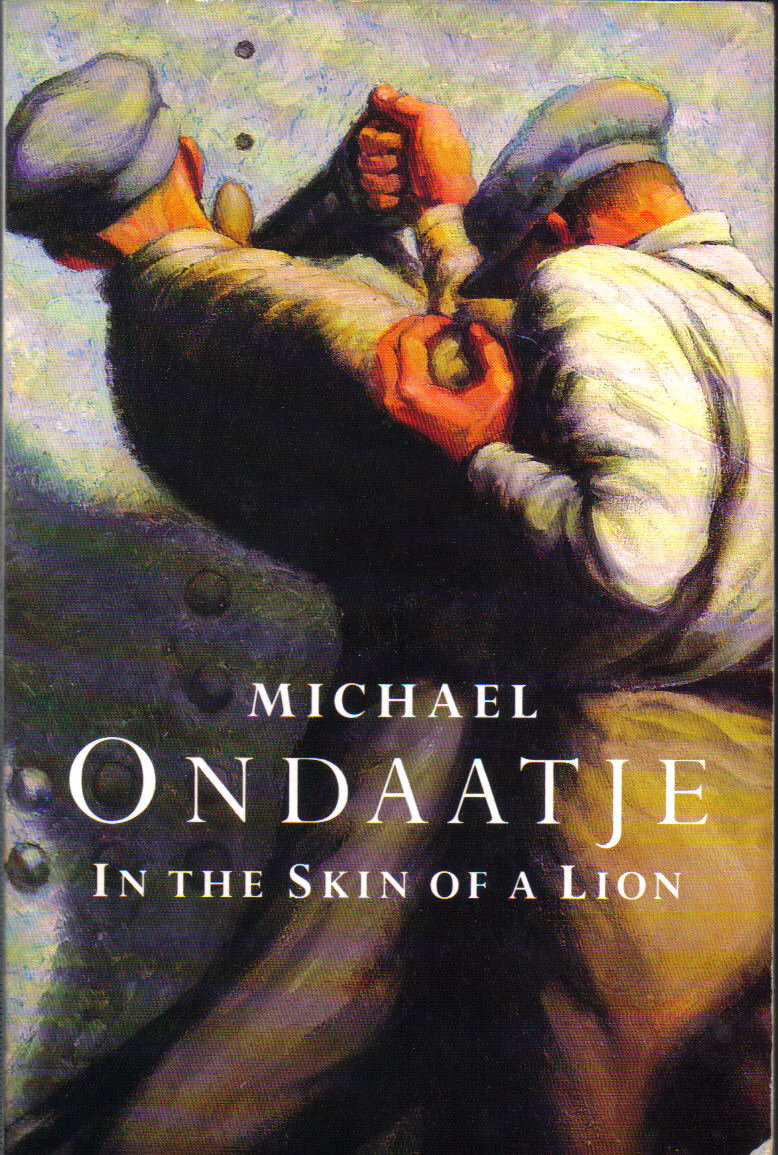
Image result for in the skin of a lion

“Each person had their moment when they assumed the skins of wild animals, when they took responsibility for the story.”

Michael Ondaatje, In the Skin of a Lion

This is, without a doubt, unequivocally, no question, stick-a-fork-in-me-I’m-done-like-dinner one my favourite quotes in the entire canon of English language literature. If you have not read this book, do not pass Go, do not collect $200, and head directly to jail (or your local library/bookstore); if you have not read anything at all by Ondaatje – fiction, non-fiction, poetry, commentary – and you are over the age of 30, go straight to the hospital, get an MRI, then tell the technician, “Shoot me now, please.”

In the Skin of a Lion is a very loose prequel to Ondaatje’s most famous work internationally, The English Patient, but the novel stands on its own two feet just fine. Aside from winning the prestigious Governor General’s Award, it has stood the test of time since being published 30 years ago and will, in my humble opinion, continue to resonate with readers for many years to come. Like, many years to come.

When writing about this novel in an academic paper, Graciela Moreira Slepoy so rightly pointed out:

“As the title of the novel indicates, to take responsibility for one’s own story and for its narration is a way of legitimising and appropriating one’s life in order to compensate for historical omissions. Alice’s explanation of the meaning of the title emphasises the importance of telling personal stories.”

An immigrant himself, Mr. Ondaatje first uprooted his life in Sri Lanka (then Ceylon) and moved to England in 1954. Eight years later, in 1962, he made his final move, to Canada, and now resides in Toronto.

In the same paper as above, Graciela Moreira Slepoy states that “In the Skin of a Lion narrates forgotten stories of those who contributed to the building of…Toronto, particularly immigrants and marginal[ized] individuals.” In the novel, this primarily centres around two pieces of highly relevant Toronto infrastructure, the Bloor Street Viaduct (Prince Edward Viaduct) and the R.C. Harris Water Treatment Plant, as well as the immigrant workers who built them.

Although a different time period than his own, this was obviously something that Ondaatje could not only sympathize with, but an experience that more than 20 years after first landing in Montreal he still felt passionate about. In 1987, he took this passion and his personal memories as an immigrant, combined them with some intense research carried out at the City of Toronto Archives,  and then brought this all together with a compelling plot and beautiful prose.

The result was the publication of one of the most important and enduring pieces of Canadian fiction – and one of its most enjoyable to read.

1 Comment

Filed under Uncategorized

Happiness, Linguistically Speaking

Image result for happiness

I’m a hopeless romantic. At least when it comes to languages, I am. Or, you know, so I’m told. (Cough) By my, you know, legion of fans. (Cough, cough, cough)

Writing for that rag (thank you, Donnie T.!) otherwise known as The New Yorker, Emily Anthes (@EmilyAnthes) wrote a great article called “The Glossary of Happiness.” I’ve written before on the wonder and magic connected to what I believe is mankind’s greatest invention, language, but in this particular piece by Ms. Anthes, she goes into detail about University of East London’s Tim Lomas (@drtimlomas), a lecturer in positive psychology, and his Positive Lexicography Project.

What in blue balls is a “lexicography project”? As always, reader, that is a fine and dandy question full of vim and vigour.

In a nut-filled nutshell, Mr. Lomas began compiling a dictionary last year of terms from languages other than English – and with a stress on languages from non-Western ideas and experiences – that have interesting words to describe some positive act, belief, event, or state of mind. The aim is to “develop a more cross-cultural view of well-being.”

Let me highlight some of my favourite inclusions that have made the final cut.

ilunga (Tshiluba): being ready to forgive a first time, tolerate a second time, but never a third time

mamihlapinatapei (Yagán) a look between people that expresses unspoken but mutual desire

tarab (Arabic) musically induced ecstasy or enchantment

queesting: (Dutch) to allow a lover access to one’s bed for chitchat (ha ha ha…chitchat…will have to explore what “chitchat” means in Dutch)

utepils (Norwegian) a beer that is enjoyed outside . . . particularly on the first hot day of the year (Note: How we as Canadians don’t have a word like this is shameful. We should languish and rot like a rotten tomato for such an oversight. The only terms I can think of that are relatively close are “patio season” or, apropos of this weekend, “May two-four”)

However, Mr. Lomas isn’t just doing this because putting together dictionaries is obviously a fun, funny and funly pastime. He’s more concerned about linguistic relativity, which “posits that language itself – the specific tongue that we happen to speak – shapes our thoughts and perceptions.” As Ms. Anthes writes:

Those who believe in linguistic determinism, the strictest version, might argue that a culture that lacks a term for a certain emotion—a particular shade of joy or flavor of love—cannot recognize or experience it at all. Lomas, like many modern linguists, rejects that idea, but believes that language affects thought in more modest ways. Studying a culture’s emotional vocabulary, he said, may provide a window into how its people see the world.

Thus, the conservative high priests of linguistic determination might say that because the Japanese don’t really have a word like “love” – as in “I love you” – and instead use the word daisuki (大好き) – as in “I like you” – that they are unable to experience this feeling the same way we do in countries like Australia, Canada, Fiji and the U.S., for example.

(As a sidebar, this is exactly what so fascinated me and formed the core theme of a short story of mine called “The Language of Love.”)

On the flip side of the proverbial coin, there is no direct translation from Korean to English for the word han (한), a derivative from Chinese (恨), and which refers to deep, deep, deep suffering/regret/resentment. It is, in my opinion, the most important word to describe ethnic Korean culture on the Korean Peninsula, but we simply don’t have a single word to wrap this one up in and tie neatly with a bow on top.

Does that mean that I, as a native English speaker from the Great White North, cannot understand this feeling or experience of han? After spending a quarter of my life living in Korea, I’d say no, I really don’t. I know pain, I know suffering, I know loss, but I don’t feel han the same way a Korean born and raised in Mokpo, for example, does.

Alternatively, that same go-getter from Mokpo cannot linguistically understand the way in which I “love” because our noun/verb version of this word is so malleable that in English we can “love” our spouse, our parents, a piece of gum, philosophy, TV shows, God, cold winter nights, and warm summer days. In Korean, you only get to use sarang (사랑) as a noun and saranghada (사랑하다) as a verb with sentient beings, and usually just with human beings at that.

So, is happiness tied to our ability to express this emotion linguistically? Saint Bonaventure is famous for once saying, “amor est magis cognitivus quam cognition,” which translates roughly into “We know things better through love than through knowledge.”

Perhaps the Kenyans don’t have as many words for “snow” as do the Inuit of Nunavut, but I’m pretty sure they’re sensible enough to know that it’s probably not a good idea to sleep on top of any kind of snow without some kind of shelter. At the same time, I’m not a Buddhist, I’m not ethnically Korean, and 한국어 is not my first language, but this deep into the ballgame otherwise known as life I sure as s*** know what sorrow and regret feel like when blended together like a tornado, even if we don’t have the perfect word in English to convey this emotion.

Leave a comment

Filed under Uncategorized