Tag Archives: Quote of the Day

Quote of the Day

Image result for hope in hands

“To love life, to love it even
when you have no stomach for it
and everything you’ve held dear
crumbles like burnt paper in your hands,
your throat filled with the silt of it.
When grief sits with you, its tropical heat
thickening the air, heavy as water
more fit for gills than lungs;
when grief weights you like your own flesh
only more of it, an obesity of grief,
you think, How can a body withstand this?
Then you hold life like a face
between your palms, a plain face,
no charming smile, no violet eyes,
and you say, yes, I will take you
I will love you, again.”

Ellen Bass (b. 1947)

I know what you’re thinking – there is a considerable amount of fromage dripping from this poem. True, but always remember that a little cheese never killed anyone. In fact, taken in moderation, like, say, one large portion of poutine a month, it’s actually quite healthy for you.

This Quote of the Day comes from the award-winning American poet Ellen Bass, who is also the co-author of the self-help book The Courage to Heal: A Guide for Women Survivors of Sexual Abuse.

What I like about this poem is that it reminds us not to glamourize life when we are stuck in one of its many sinkholes. Acceptance, hope, life and love can coalesce, just not always in that romantic way we like to think when things seem shitty to quite shitty. Sometimes it’s best to simply reexamine life for what it is, a Plain Jane face lacking any charm or sparkle to the eye. But re-embrace it, we do, because it is our life. And as William Ernest Henley reminded us so eloquently almost a century and a half ago:

It matters not how strait the gate,
      How charged with punishments the scroll,
I am the master of my fate,
      I am the captain of my soul.


Leave a comment

Filed under Uncategorized

Quote of the Day

Image result for black and white, mother

“The heart of a mother is a deep abyss at the bottom of which you will always find forgiveness.”

Honoré de Balzac

In “honoré” (hot diggity – dog ziggity boom – I’m funny!) of the fact that my new office is a coffee shop called Balzac’s, that the first book I ever read for a book club 13 years ago was Dai Sijie’s Balzac and the Little Chinese Seamstress (great book, beautiful cover design by the way), and that my mum is a 24/7 rock star, I dedicate this Quote of the Day to her – and to all the moms out there who practice forgiveness on a daily basis with aplomb, like it’s a freakin’ walk in the park, the easiest thing in the world to do.

Balzac was a bit of a bad-ass rebel in his day, the early 19th century. Born in the same year as Alexander Pushkin, Balzac followed a professional path not totally dissimilar to that of another towering artistic figure – Wassily Kandinsky. Both would start out in law, quickly grow bored of its banality, and move on to writing and painting, respectively. More than that, both would go on to shape their respective fields like few before or after them.

I’ll finish this post off with one more quote from Balzac that I’ve always wholeheartedly believed in:

“There is no such thing as a great talent without great will power.”

Leave a comment

Filed under Uncategorized

Quote of the Day

Image result for beautiful canyons

“Should you shield the canyons from the windstorms you would never see the true beauty of their carvings.”

                                                 Elisabeth Kübler-Ross 

There are times you read something and it just hits you in the gut with explosive force, perhaps because of the beauty of the prose, the fact that you relate to it so viscerally, or – like in cases such as this Quote of the Day – both at the same time.

Before today I wasn’t familiar with name Elisabeth Kübler-Ross, but now I realize how influential she was in her long and accomplished life.

Per Ms. Kübler-Ross’s bio on Goodreads:

Elisabeth Kübler-Ross, M.D. was a Swiss-born psychiatrist, a pioneer in Near-death studies and the author of the groundbreaking book On Death and Dying (1969), where she first discussed what is now known as the Kübler-Ross model. In this work she proposed the now famous Five Stages of Grief as a pattern of adjustment. These five stages of grief are denial, anger, bargaining, depression, and acceptance. In general, individuals experience most of these stages, though in no defined sequence, after being faced with the reality of their impending death. The five stages have since been adopted by many as applying to the survivors of a loved one’s death, as well.

Leave a comment

Filed under Uncategorized

Quote of the Day

Image result for wonder in space

Before this morning, I’d never heard of Diane Ackerman, who, according to Wiki, “is an American poet, essayist, and naturalist known for her wide-ranging curiosity and poetic explorations of the natural world.”

However, while poking around the interweb on the subject of wonder, I came across this little golden nugget of nuggetness:

“Wonder is the heaviest element on the periodic table. Even a tiny fleck of it stops time.”

I like prose that hits the mark in as few words as possible, a rule I’m constantly reminded I break all the time. Nonetheless, I enjoy reading it from others.

With today’s Quote of the Day, something about its simplicity caught my attention and I felt compelled to jot it down. Philosophers have long talked about the critical difference between questioning and having a sense of wonder and I have to agree. It’s that small yet significant variance in meaning – one for answers to the unknown, one for maintaining astonishment at the world around you – that I believe is a defining trait to a healthy, vibrant, creative mind.

I suppose that when many of us think of “wonder” we think of things like the miracle of birth, the gift of love, the pleasant shock of the unexpected, or perhaps just a gargantuan object in nature like Everest or the Grand Canyon. Yet what I like about Ackerman’s quote is that she mentions how “even a tiny fleck of it stops time.”

So true. Who was it that first said God is in the small things? Anyway. Doesn’t matter. Someone long, long ago realized this and we’re still reveling in its meaning today, as I am with Diane Ackerman’s quote.

Leave a comment

Filed under Uncategorized

Quote of the Day

Image result for Lycophron of Corinth

“Why seek to cure evil by evil? Mercy, remember, is by many set above justice…Power is a slippery thing – it has many suitors.”

Lycophron of Corinth’s Sister

So, to begin, a few disclaimers. (1) The above bust is of Periander, the father of Lycophron. I assume they looked relatively alike (and busts from back then are hard to come by), so it’ll have to do; (2) I don’t know what the sister’s name is because she’s called “Lycophron’s sister” in The Histories; (3) The above quote comes from Herodotus, whom many consider to be “The Father of History,” so I’m not sure if we can verify with any certainty the exact words the sister used 2,600 years ago; (4) “the results of the enquiry carried out by Herodotus of Halicarnassus” (aka The Histories) was one of the subtlest – but most romantic/intriguing – elements to the relationship between Count Almásy and Katharine Clifton in Ondaatje’s The English Patient.

But back to the Quote of the Day!

Somewhere in the ballpark of two and a half millennia ago, Lycophron’s sister is said to have uttered these words about mercy. I’m not sure if she was referring to one person or event in particular, but it’s quite possible she was thinking about her father, otherwise known as the Second Tyrant of the Cypselid dynasty that ruled over Corinth. However, this same tyrant was also considered one of the Seven Sages of Greece, so perhaps he wasn’t all bad and his daughter was just waxing poetic for no special reason.

Either way,  I’m not sure what it was about the Ancient Greeks, but it seems as if they all nailed their aphorisms effortlessly. Like the following conversation, which very well could have been an everyday moment shared between two Greeks:

“Hey, Plasticoratorus, are you going to apply for that job you mentioned?” 

“I haven’t made up my mind yet. Neverthless, let us spare no pains; for nothing comes without trouble; but all that men acquire is got by painstaking. What about you, Socratotalitis? Any plans to do anything but drink wine and carry on with your symposiums?”

“Ha ha, Plasticoratorus. I can sense the irony and envy in your voice. Remember, when men counsel reaosnably, reasonable success ensues; but when in their counsels they reject reason, God does not choose to follow the wanderings of human folies.”

“Well done, Socratotalitis. Your pithy pithism Trumped my circuitous mental aberration.”

In the case of today’s Quote of the Day, Lycophron’s sister was clearly a visionary ahead of her time. Even today in what are arguably the two world’s most powrful countires (America and China) not only is captial punishment still practiced, but these respective governments seem to imprison people with impunity.

Leave a comment

Filed under Uncategorized

Quote of the Day

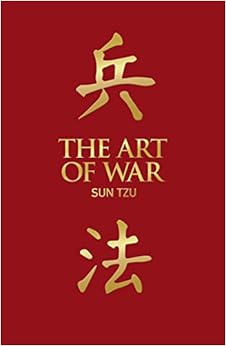
Image result for the art of war

“Pretend inferiority and encourage his arrogance.”

Sun Tzu, The Art of War (5th century BCE)

Even if you haven’t read The Art of War, you’re probably familiar with many of its now-famous axioms, most of which relate to military strategy and tactics, but can be just as easily applied to day-to-day stuff, business, sports, and pretty much everything else in life.

Here are a coupe of other doozies from Sun Tzu (544-496 BCE):

“Appear weak when you are strong, and strong when you are weak.”

“If you know the enemy and know yourself, you need not fear the result of a hundred battles. If you know yourself but not the enemy, for every victory gained you will also suffer a defeat. If you know neither the enemy nor yourself, you will succumb in every battle.”

“Treat your men as you would your own beloved sons. And they will follow you into the deepest valley.”

Although we have only had an annotated English translatin of The Art of War from its original Classical Chinese since 1910, when Lionel Giles seemed to accomplish the linguistically impossible, its effect on Western culture was immediate and profound.

Sadly, as the American Century – from its entrance onto the word stage as the NKOTB at the tail end of World War I in 1917 to the swearing-in of Donald Trump as President in 2017 – draws to a close, I can’t help but wonder if the current U.S. Commander-in-Chief didn’t perhaps get his Art of War on through the wrong medium, instead using Mr. Snipes as his inspiration to lodge a war with the world.

After watching the goings-on at the White House over the last five months or so, another military strategist I think about is Napoleon Bonaparte, a complex character who could come up with dynamite little quips in a short amount of time, kind of like this one: “Never interupt your enemy when he is making a mistake.”

Indeed, we won’t. After all, who needs any of that phony baloney bread or circus stuff when we’ve got Donnie T. shooting himself in the foot with a mouth-propelled rocket on a daily basis. I’ll tell you who really needs the bagutte and Cirque de Soleil action – the infamous secret agenct, Señor Covfefe of Mexico.

Leave a comment

Filed under Uncategorized

Quote of the Day

Image result for gore vidal

“The four most beautiful words in our common language: I told you so.”

Gore Vidal

I’m having one of those “I-told-you-so” days, so thought this Quote of the Day was particularly apropos. It all started when I went to the post office to return some merchandise the S.O. bought a couple of weeks ago after being assured in an online ad (i.e. scam) that the beauty products were FREE! FREE! FREE! as long as you filled out a short survey (i.e. you provided your phone number, email and mailing address).

To which I replied, “Nothing in this world is free.”

To which the S.O. replied, “No, no, no. This time it really is free. I swear.”

To which I so wittily and handily replied, “Indeed, you do have a potty mouth, but it doesn’t change the price of tea in China, nor does it make these things free.”

After numerous phone calls to a “No Caller ID” with a P.O. Box as an address, and of course the requisite $30 in postage, the matter is now settled.

I’ll shorten the above witticism to three words: Told ya so.

But back to Gore Vidal, one of those rare – like, really rare – writers that intimidated fellow authors, pundits, critics and politicians back in his day because of his pedigree, breadth of knowledge, Transatlantic accent (ha ha ha), and overall confidence (i.e. smugness) that was perpetuated as much by myth as it was by a shocking understanding of what appeared at times to be everything and everyone. If you’ve ever read Somerset Maugham’s The Razor’s Edge, Gore Vidal was pretty much the real-life version of Elliott Templeton.

Personally, my favourite book by Mr. Vidal was The Golden Age,  a novel that offers readers the same kind of inside look into a fascinating period of world history/World War II as Norman Mailer’s The Naked and the Dead; with the former, we’re taken inside the White House and the inner sanctum of FDR; in the case of the latter, we have a firsthand look into how generals plotted the insanely complicated island-hopping battles against the Japanese during the Pacific Campaign.

If you have yet to read anything by Gore Vidal, there’s a ton of material online, from essays and articles to brilliant one-liners and general observances, so go and check him out. Then I can tell you, I told you so!

1 Comment

Filed under Uncategorized

Quote of the Day

Image result for rules for being human

  1. You will receive a body.
  2. You will learn lessons.
  3. There are no mistakes, only lessons.
  4. A lesson is repeated until learned.
  5. Learning lessons does not end.
  6. “There” is no better than “here.”
  7. Others are merely mirrors of you.
  8. What you make of your life is up to you.
  9. Your answers lie inside you.
  10. You will forget all this.

10 Rules for Being Human” (from If Life Is a Game, These Are the Rules), Cherie Carter-Scott

I don’t think I would have ever written down this list in my literary journal 20 years ago if it hadn’t been for No. 10. Priceless. Like, toooootally MasterCard priceless.

There’s really no rhyme or reason to my selection for the Quote of the Day. Each one just kind of comes to me no differently than cosmic dust filtering in from the farthest reaches of the “Chocoalte Bar” Galaxy, penetrating our now ozone-less atmosphere, and then connecting with my uber sensitive-to-the-universe brain. That’s what happened this morning after I’d finished my 200th sit-up and was getting ready to do 100 chin-ups before getting started on my daily half-triathalon. Wednesdays are full-out triathalons.

Man, I love fitness!

I don’t know much about Dr. Cherie Carter-Scott (@DrCherie) except (1) I can’t cut and paste the accent aigu over the first “e” in her name; (2) she is known as the “Mother of Coaching” (anyone know who the Father is? Could it be Vader?); (3) she has been a self-dubbed “pioneer in the field of Human Development and Motivation since 1974,” the year the world stood still on June 19; and (4) I really liked the above “10 Rules for Being Human,” and have ever since I came across it for the first time in 1997, the year the world stood still once again on August 31 and September 5.

Click here if you’d like to learn more about Ms. Carter-Scott.

1 Comment

Filed under Uncategorized

Quote of the Day

Image result for 419
“[M]y fear is that when we die, we’ll have to watch all those moments in our lives when we were short-tempered with our children, all the times they needed our love and we didn’t give it, all those times we were distracted or in a bad mood, and all the times we were angry or impatient. My fear is that when the time comes, I’ll have to watch all those moments again. That they’ll make us watch them before we can get into Heaven.”

Will Ferguson, 419

I know what you’re thinking: Why would you name your novel after an area code? While that is a good and dandy catechism of the secular, non-political variety, the title is not in fact a way to call Toledo, Ohio, but refers to a section of the Nigerian Criminal Code that deals with fraud, as well as the charges and penalties for offenders of this crime.

I also know what you’re thinking right now: Nigeria? Why would that fine, upstanding country need Article 419 as part of its Criminal Code? I’ll let Will Ferguson answer that one through his Giller Prize-winning novel of the same name, err, number.

Before I move on, however, let me provide you with a classic 419 email.

Subject: USE FOR THE LESS PRIVILEGED From: “Mrs.Isabella Caromel” <isabecaromel1515@yahoo.com.my>

Good day
Private Message to you,

This is an important message to you.The lord directs me to share this with you. As you read the mail, you should sympathize with my current situation and assist me. My name is Isabella Carmel the only survivor from family of four. I was narrowly escaped from the tsunami disaster which affected my spinal cord and also my ear drum and claim the lifes of my entire family, husband (Denis caromel) and two sons (Ugo and Tom) who went for holidays in Sri-Lanka.

Right now I am currently in Kuala Lumpur Malaysia. After staying a week in my family hospital, I was disabled by the catastrophe and now on a wheel cheer after all the treatment.This has defiled all forms of medicine and right now I have only about a few months to live, according to medical experts.I have not lived my life so well as my primary interest and focus was only on my late fathers business. Though my father is very rich and was never generous. But now I regret all this, as I know that there is more in life than just wanting to have or make all the money in the world.The bible says what shall it profit a man to wine the whole world and loose his soul. I believe when God gives me a second chance to come to this world I will live my life a different way from how I have lived before. I have willed and given most of my fathers properties to the less privileges because I want God to be merciful to me and accept my soul. I have decided to give arms to charity organizations and give succor and comfort to the less privileged in our societies. I want this to be one of the last good deeds I do on earth since my father has never recognized that.

So far I have to distribute money to charity organizations now that my health has deteriorated so badly,I cannot do this myself anymore that is why am soliciting your assistant to make this donation through you. The last of my late fathers money that am willing to donate to the less privileged right now is the huge sum of $10.6M USD that is concealed in a consignment and deposited in (OVERSEA CREDIT COMMISSION ABROAD) for safekeeping which he intends to invest on profitable factory.

I want you to help me claim this funds where is deposited and disburse it to charity organizations and the less privileged in the society.Please I will appreciate you to indicate interest for the disbursement and also include your contact telephone/fax numbers that I will forward to the(OVERSEA CREDIT COMMISSION ABROAD) to be able to contact you as the appointed beneficiary. I will provide you the certificate of deposit and the letter of authority to enable you claim the consignment of the funds.

If you are willing and ready to assist with this project,please e-mail me at isabecaromel900@myway.com without delay, while I wait to hear from you.Thanks once again for your kindness may God guide and reward you in all your endeavors as you make me realize my last dreams and wishes.

Remain blessed,
Mrs.Isabella Caromel

Now that’s the $$$ shot! Good on ya, Mrs. Isabella. Heart goes out to you. For trues and for reals!

Anyway, 419 is a very good book and the above quote is quite poignant. However, if you want to listen to a podcast that takes it about 156 steps past what Mr. Ferguson did with his novel, check out NPR’s This American Life, Episode 363: Enforcers and click on Act One, “Hanging in Chad.” These guys take “revenge is a dish best served cold” to new heights.

Leave a comment

Filed under Uncategorized

Quote of the Day

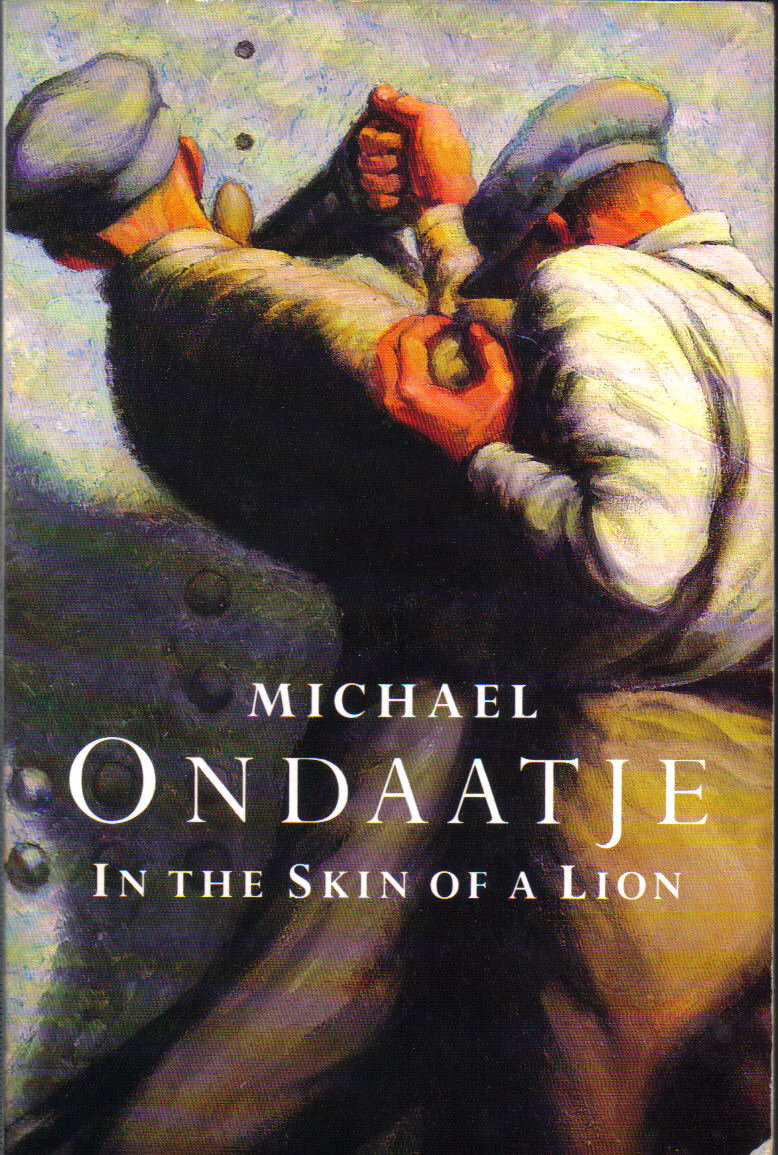
Image result for in the skin of a lion

“Each person had their moment when they assumed the skins of wild animals, when they took responsibility for the story.”

Michael Ondaatje, In the Skin of a Lion

This is, without a doubt, unequivocally, no question, stick-a-fork-in-me-I’m-done-like-dinner one my favourite quotes in the entire canon of English language literature. If you have not read this book, do not pass Go, do not collect $200, and head directly to jail (or your local library/bookstore); if you have not read anything at all by Ondaatje – fiction, non-fiction, poetry, commentary – and you are over the age of 30, go straight to the hospital, get an MRI, then tell the technician, “Shoot me now, please.”

In the Skin of a Lion is a very loose prequel to Ondaatje’s most famous work internationally, The English Patient, but the novel stands on its own two feet just fine. Aside from winning the prestigious Governor General’s Award, it has stood the test of time since being published 30 years ago and will, in my humble opinion, continue to resonate with readers for many years to come. Like, many years to come.

When writing about this novel in an academic paper, Graciela Moreira Slepoy so rightly pointed out:

“As the title of the novel indicates, to take responsibility for one’s own story and for its narration is a way of legitimising and appropriating one’s life in order to compensate for historical omissions. Alice’s explanation of the meaning of the title emphasises the importance of telling personal stories.”

An immigrant himself, Mr. Ondaatje first uprooted his life in Sri Lanka (then Ceylon) and moved to England in 1954. Eight years later, in 1962, he made his final move, to Canada, and now resides in Toronto.

In the same paper as above, Graciela Moreira Slepoy states that “In the Skin of a Lion narrates forgotten stories of those who contributed to the building of…Toronto, particularly immigrants and marginal[ized] individuals.” In the novel, this primarily centres around two pieces of highly relevant Toronto infrastructure, the Bloor Street Viaduct (Prince Edward Viaduct) and the R.C. Harris Water Treatment Plant, as well as the immigrant workers who built them.

Although a different time period than his own, this was obviously something that Ondaatje could not only sympathize with, but an experience that more than 20 years after first landing in Montreal he still felt passionate about. In 1987, he took this passion and his personal memories as an immigrant, combined them with some intense research carried out at the City of Toronto Archives,  and then brought this all together with a compelling plot and beautiful prose.

The result was the publication of one of the most important and enduring pieces of Canadian fiction – and one of its most enjoyable to read.

1 Comment

Filed under Uncategorized