Tag Archives: reading

Do Audiobooks Count as Reading?

How I like to get my audiobook on

In a piece for The New York Times, Brian Bannon, chief librarian at the New York Public Library, answers a question I imagine many book club members worldwide have asked themselves at one time or another: “Do Audiobooks Count as Reading?”

In case you don’t have a digital subscription to the Times, I’ll highlight some of the more memorable points. Today, 41% of adults don’t believe audiobooks qualify as reading. Yet, as Bannon points out, “learning to read with the eyes starts with decoding, linking letters to sounds and meaning. But once those pathways are built, the brain draws on the same language network to make sense of words, whether they arrive through sight or sound.”

Audiobooks not only allow blind people to become “absorbed in the words, taking in their meaning,” but also assist people with dyslexia, like the author of the article, to “effortlessly absorb ideas and focus in a way I hadn’t before.”

Interestingly, listening to books is on the rise: “Audiobook sales reached about $2.2 billion in the United States last year. At the New York Public Library, audio circulation rose 65 percent in the past five years while circulation for print and e-books stayed flat — a pattern mirrored nationwide. Audio has overtaken e-books in driving growth.”

In my own book club, we 12 readers are never on the same page (groan) when it comes to how we “read” our shared literary journey every month. Although I don’t have any hard stats to back this up, I’d say we’re roughly 40% physical book, 30% e-book, and 30% audiobook. Personally, I’m around 50/50 with the physical copy and e-book (shout-out to the Toronto Public Library for having seemingly every book under the sun and free delivery of physical books to my home branch).

That being said, I do listen to the odd book now and again. In the case of Bono’s Surrender, that actually saved me. When I found myself not fully engrossed in the reading aspect of the story, I switched to the audiobook and ended up finishing it (all 845 hours . . . give or take) quite happily. In another instance, we read David Grann’s The Wager not long ago and a few of my fellow book club members swore by the audiobook, saying there was no chance they would have finished it without the euphonious voice of the man responsible for reading it to them.

On a final note, I liked loved the conclusion to the piece Brian Bannon wrote, as it essentially captures why I started a book club in the first place 16 years ago: “However we read — by eye, by ear or both — it all counts. What matters is that the words get in, the brain makes meaning and the identity of being a reader takes hold. We need more readers, however they get there.”
Leave a comment

Filed under Uncategorized

A History of Reading

Image result for a history of reading

If you like reading, you’ll probably like this book. If you love reading, you will love this book. And if you adore reading like it’s a source of oxygen, then you will go cuckoo for Cocoa Puffs when you start this book.

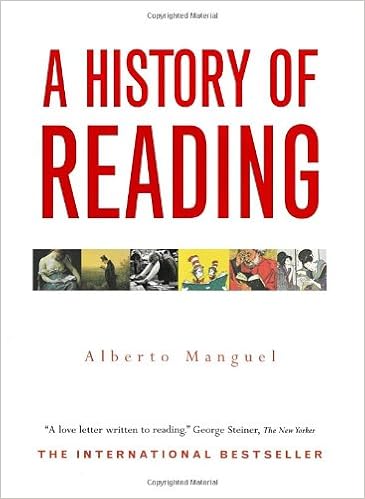
In 1997, Argentine-Canadian Alberto Manguel published an immensely engrossing book called A History of Reading, a love letter, as it were, to readers everywhere throughout the ages. As his publisher puts it:

“At one magical instant in your early childhood, the page of a bookthat string of confused, alien ciphersshivered into meaning. Words spoke to you, gave up their secrets; at that moment, whole universes opened. You became, irrevocably, a reader. Alberto Manguel moves from this essential moment to explore the 6000-year-old conversation between words and that magician without whom the book would be a lifeless object: the reader. Manguel lingers over reading as seduction, as rebellion, as obsession, and goes on to trace the never-before-told story of the reader’s progress from clay tablet to scroll, codex to CD-ROM.”

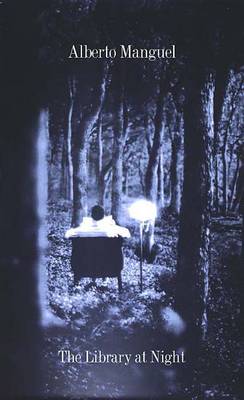
For those bibliophiles and word nerds out there who can’t get enough book-related stuff, Mr. Manguel also has another interesting nonfiction book called The Library at Night. It’s sexy. It’s mild. It’s a sexy mild read.

Image result for the library at night

In a similarly related piece, Nicholas Cannariato penned a thought-provoking piece for @The_Millions called “Why We Read and Why We Write.” As Mr. Cannariato says:

“Reading then is a moral and subversive act in its own right. It’s a disengagement from the commercial and competitive in pursuit of heightened moral sense coupled with aesthetic and intellectual engagement. Reading doesn’t produce ‘work’ itself as ‘producerist’ ideology would have it, but rather it cultivates the intangibles that go into that work. What we gain by reading is what we often strive for in life when we’re actually thinking about what we want.”

But perhaps the most hilarious quote from this piece (and something which would likely make Stephen King hunt down and “Misery” the male colleague in question here) is the following: “Sheila Liming, in her recent essay “In Praise of Not Not Reading,” recounts a male colleague pursuing an MFA in fiction tell her he literally didn’t believe in reading. ‘I’m a writer, I make things,’ he said, ‘whereas you’re a reader, you consume things.'”

Image result for angry man with a book

Anyone have a candlestick, knife, rope, dumbbell, trophy, poison, lead pipe, revolver, or wrench handy for Professor Douchebag?

Leave a comment

Filed under Uncategorized

Book Clubs

“Book clubs are totally dope – like English class if you were allowed to read only books that you actually like and snack and sip while discussing them.”

Sam Maggs, The Fangirl’s Guide to the Galaxy: A Handbook for Girl Geeks

…and by “sip” I assume Sam means kegstands with beer and wine straight from the bottle, and by “snack” she means stuffing your face with greasy food straight from the back of a pub.

Last night my book club talked about Jennifer Egan’s Manhattan Beach. According to one of my fellow bookies who shall remain nameless but has a history of bibliophilic illness, “Manhattan Beach is a book about a beach. The beach is called Manhattan Beach. In between going to the beach and Anna’s home, people go diving and die. The end.”

Excellent summary.

Anyway, aside from plugging my own book club (did that come out right?), I thought I would use this opportunity to highlight the awesomenesss of book clubs. On top of meeting new people (hopefully), being in a book club means you have an excuse every month to rip it up while discussing pretentious subjects like art, literature, the art of literature, and literary art. Oh, and artistic literature, too.

I started this book club, Curling Was Full, in August 2009 and I’m proud to say we’re still going strong. Members have come and gone (there are only an Original Three left), but we always seem to have more requests for membership than we can handle. No surprise, then, that when Random House (before it was Penguin Random House) had a book club contest called Books Are Beautiful, we won!

Actually, we finished in second place (we all received a copy of Jowita Bydlowska‘s Drunk Mom) to We Don’t Bake Muffins, but I’m still convinced the contest was rigged. Something about screeching the judges and kissing a cod, I’m told.

Long of the short, though, if you’re not in a book club, start one. If you are in one, lament the fact that you’re not in Curling Was Full because, well, we’re full.

Leave a comment

Filed under Uncategorized

You Are What You Read


This is your brain on books. Most of the time.

In a piece titled “Tell Me What You Read, And I’ll Tell You Who You Are.” Zat Rana (@Zat_Rana) explains how the books we read shape our thoughts. As he puts it:

You are what you read. The information that you input into your mind informs your thinking patterns, and it influences your output in the form of the decisions you make, the work you produce, and the interactions you have.

This is of course not a news flash — to most of us. But Mr. Rana is specifically concerned with our reading habits and what it is we’re taking in on a daily basis. Consider the following:

In the last 10 years, the number of books published per year has doubled.

10 times more data will be produced in 2020 than was produced in 2013.

We live in age of information overload, and the ability to distinguish value from noise is going to become an increasingly critical quality.

The effects of reading aren’t always obvious, and as a result, many of us don’t always pay attention to what our brain is processing, and we just go along in whatever distraction the world guides us. That’s not the way ahead.

I’ve espoused the utility — and joy! — of reading recreationally more times than I can remember, but as Zat Rana concludes in a succinct manner:

At the end of the day, one of [the] most important skills in your life is how you think. It affects everything from what you produce to how you see the world. It’s on you to improve that by consuming input of value.

View at Medium.com

Leave a comment

Filed under Uncategorized