Category Archives: Uncategorized

The Nobel Prize in…Lyrics?

Image result for totally confused reader

Something is rotten in the state of Denmark. Thanks, Will (wink, wink).

Just because you love a person’s work, doesn’t mean you get to change the rules when categorizing it. While some are ecstatic that the world is becoming less rigid in its definition of people and objects – some choose not to be identified by a male or female pronoun and God only knows what the meaning of an American Republican is anymore, for example – there are benefits to having structure, namely, the ability to form logical thoughts and opinions which can then be communicated to others without detailed explanation.

Which brings us to Mr. Zimmerman and his winning of the 2016 Nobel Prize in Literature today. I’d heard that his name was being kicked around for years, but never actually thought he’d win the award. Guess I was wrong.

I suppose the conundrum I’m faced with (and don’t get me wrong, I enjoy Bob Dylan’s music just as much as the next person) comes more from a linguistic approach.

The word “literature” is defined as:

noun

1.

writings in which expression and form, in connection with ideas of permanent and universal interest, are characteristic or essential features, as poetry, novels, history, biography, and essays.
2.

the entire body of writings of a specific language, period, people, etc.:

the literature of England.
3.

the writings dealing with a particular subject:

the literature of ornithology.
4.

the profession of a writer or author.
5.

literary work or production.
6.

any kind of printed material, as circulars, leaflets, or handbills:

literature describing company products.


In a broader sense, the word “literature” can technically include any type of writing on a particular subject, like the literature of supply-side economics.

Does that mean that Robert Mundell should have been awarded the Nobel Prize in Literature – and not Economics as he was – in 1999? I mean, Mundell did, after all, write extensively on the subject of supply-side economics.

Speaking of which, at least the “Economics” Nobel has gone through 12 name changes since its introduction in 1969, so it’s already admitting the award is for, roughly translated, someone who talks/writes about things with the word “economy” or “economics” in it.

If the higher-ups at Nobel, Inc. were comfortable introducing a new prize category in 1969, long after the inventor of TNT’s death, then why not just introduce a Nobel Prize for Music? Like soccer, it’s a universally binding force that has a tremendous impact on the world, right?

Now, granted, the Swedish Academy (which awards the Literature Prize) has made some pretty stellar decisions in the past. They’ve overlooked little-known and obscure people in the field of literature before, such as Henrik Ibsen, Henry James, James Joyce, Leo Tolstoy and Mark Twain. In 1974, after discounting writers that included Saul Bellow, Graham Greene and Vladimir Nabokov, they shrewdly gave the award to literary rock stars Eyvind Johnson and Harry Martinson. Sorry, what’s that? No, no, no. They’re not members of ABBA; they were members of the Swedish Academy that very same year.

Barf.

If I were a betting man, which I am, then I’d put my money on Bob Dylan being a fine choice for the 2016 Nobel Prize for Literature, which I won’t.

Do you not see something inherently wrong with that last statement?

As a curling colleague of mine and upstanding man of letters said to me this morning, “I’d rather an obscure Lithuanian rapper have won the award.”

Yes, indeed, something is most definitely awry in the state of Den…err…Sweden.


1 Comment

Filed under Uncategorized

Quote of the Day

Image result for imagination

The novel I’m working on right now, The Redemption of Guilt, has a supporting character who is deeply inspired by Albert Einstein. So, apropos of my imaginatively borne character Tariq, I present to you the short, sweet, and simple Quote of the Day:

Imagination is greater than detail.

Leave a comment

Filed under Uncategorized

Adventures in Russia’s Far East

I’m a sucker for good adventure stories, fiction or non-fiction. From The Count of Monte Cristo, The Arabian Nights: Tales from a Thousand and One Nights and Heart of Darkness to Herodotus’s The Histories, The Travels of Marco Polo, Jon Krakauer’s Into Thin Air and Robert Young Pelton‘s The Adventurist: My Life in Dangerous Places, they all have a jaw-dropping story to tell in far-off lands and bygone eras.

But not all great adventure stories are by famous writers or about well-known places like Mt. Everest, Timbuktu or Shangri-La.

Take, for example, Donald Clark’s Living Dangerously in Korea,  easily one of my favourite books on my second home.

Another example is a new literary work to join the ranks of awesome adventure stories, an updated translation from the legendary explorer of Russia’s Far East named Vladimir Arsenyev. While serving in the Russian Imperial Army, Arsenyev travelled extensively throughout the region from 1902-1930, subsequently wrote about his experiences in great detail, and, so I’m led to believe, in beautiful prose devoid of any hubris. (NOTE TO SELF: Does every Russian writer always knock it out of the park?)

Yet Stalin, in all his wisdom, thought it would be a stupendous idea to censor much of Arsenyev’s writing (the original books were finally released in Russian in 2007). However, it was only when a young go-getter from the U.S. named Jonathan Slaght recently retranslated the original account (written in Russian) of Arsenyev’s first book, Across the Ussuri Kray (1921), and published it under the same name through Indiana University Press (2016), that we English readers got a sense of what the Wild East was once like.

Slaght is now the Wildlife Conservation Society’s coordinator for Russia and Northeast Asia, and Michelle Nijhuis wrote a thoroughly engaging piece in this week’s The New Yorker about Ansenyev and Slaght (make sure you check out the photo gallery, which is almost like a journey to another world). If you’re intrigued about what a pre-industrial Russia’s Far East looked like a century ago – the only place on Earth where brown bears, leopards and tigers co-exist because the region was spared from being touched by glaciation during the last Ice Age – take the time to read this article entitled “A Fuller Vision of Russia’s Far East.”

Leave a comment

Filed under Uncategorized

Quote of the Day

Image result for national coming out day

It may seem like there’s a new National/International Day of SOMETHING every morning you wake up, but some do a better job of raising awareness than others. In light of yesterday’s National Coming Out Day (October 11), I’ll let Tom Blunt from signature-reads.com set this one up:

“To those looking on from the outside, coming out as queer may no longer seem like a terribly momentous occasion. This act, however, remains a singular event in the life of anyone who’s been keeping a pivotal part of themselves concealed — whether deliberately, or because their natural comportment causes them to pass among others undetected.”

In light of this theme, I’d like to offer a quote from the amazing James Baldwin and his seminal work of fiction, Giovanni’s Room (1956), which would have required great pathos to write and herculean strength to publish back in his day.

“People can’t, unhappily, invent their mooring posts, their lovers and their friends, anymore than they can invent their parents. Life gives these and also takes them away and the great difficulty is to say Yes to life.”

Leave a comment

Filed under Uncategorized

Quote of the Day

Image result for maya angelou

Maya Angelou was a titan of 20th-century American letters. Probably best known to most as a poet and the author of I Know Why the Caged Bird Sings (1969), she was also an influential civil rights activist and voice for both African-Americans and women as a whole for decades.

There are many beautiful and inspirational examples of her writing I could choose from when it comes to quoting Ms. Angelou, but I like this one below, partly because it’s simple and poetic, but also because I too believe in this life mantra.

“My mission in life is not merely to survive, but to thrive; and to do so with some passion, some compassion, some humor, and some style.”

Leave a comment

Filed under Uncategorized

A Word We Need in English

Image result for tsundoku

What would we do without borrowed words? Unless you live in France or North Korea, you undoubtedly have hundreds, if not thousands, of loan words you use on a daily basis without even realizing it. Have you  ever seen someone’s doppelgänger in public? Thank you, German. And how calls it a tidal wave anymore? It’s a tsunami, thank you very much, Japanese. Modus operandi, aficionado, prima donna, chutzpah? Thank you Latin, Spanish, Italian and Yiddish

I’ve said it once and I’ll say it again: I love languages. Many thanks to Jase in Space for sending me this link to openculture.com.

Even the most voracious readers are guilty of buying more books (or borrowing books from friends/taking out books from the library) than we end up reading. Often, these same books begin piling up like paper pagodas. In extreme cases (hint, hint, producers of Hoarders), entire rooms are taken over by the written word.

Although this may sound, I don’t know, rustic (?) – perhaps even a little sexy mild to all you book lovers out there – all these centuries on and we still don’t have a word for this behaviour in English.

“Hey, Miffy, I hear you’re a piler-up of literary works!”

Something about that statement rings decidedly hollow.

Alternatively, Japanese does in fact have a word for this. It’s called tsundoku, and here’s the exact definition:

(n.) buying books and not reading them; letting books pile up on shelves or floors or nightstands

So the next time you walk into a person’s office/room/home and see a cornucopia of paper pagodas and want to look both enlightened and pretentious, you can say, “Man alive! You sure do know how to tsundoku your space!”

P.S. In case this same person(s) has difficulty figuring out how to deal with the aforementioned problem, direct them to the photo at the top of this post.

Leave a comment

Filed under Uncategorized

World Mental Health Day

Image result for world mental health day

In support of #WorldMentalHealthDay, which falls today, October 10, I’d like to point out a few things.

1) It’s encouraging to see countries finally starting to realize that mental health is not a stigma, but a bona fide disease. In Canada, for example, 20% of us Canucks will experience some form of mental illness in our lifetime.

2) Kudos to Bell Canada through its Let’s Talk campaign, and its spokesperson, Olympic champion Clara Hughes, for making this a subject of national conversation here North of 49. Since its launch in 2010, the initiative has raised more than $50 million, and plans to raise at least $100 million for mental health-related projects by 2020

3) Here in Toronto, the Centre for Addiction and Mental Health (CAMH) is playing a hugely positive role in addressing this issue and subsequently treating the disease to the best of its ability. Of course, places such as CAMH could always use more funding – especially private donations – but despite  allegations from someone south of the border whose skin tone matches his man rug, Canada’s healthcare system (and by extension its mental healthcare system) is not “catastrophic,” nor do we head en masse to the U.S. for medical treatment annually. (In a comprehensive study of 18,000 men and women that was published in the journal Health Affairs, 0.005% of Canadians received medical care in the U.S. based on a recommendation from their doctor, while a mere 0.001% did so of their own volition.)

4) There are a million and one scholarly books on the subject of mental health, yet there are also a number of down-to-earth fiction/non-fiction works on the subject, too. Goodreads.com has a pretty long list of books shelved as mental-health, with some of the top-rated ones (in alphabetical order by title) being the following: All the Bright Places by Jennifer Niven, The Center Cannot Hold: My Journey Through Madness by Elyn R. Saks, Impulse (Impulse #1) by Ellen Hopkins, Equating the Equations of Insanity: A Journey from Grief to Victory by Durgesh Satpathy, The Perks of Being a Wallflower by Stephen Chbosky, and Still Alice by Lisa Genova.

(P.S. Many of these same writers are what are known as “Goodreads Authors,” meaning they often hold chat sessions with readers in real-time through goodreads.com, and sometimes even take personal emails to talk about their work(s).)

2 Comments

Filed under Uncategorized

Quote of the Day

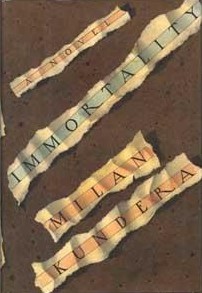
Image result for milan kundera immortality

Milan Kundera is one of the more interesting characters in the world of literature. A political maverick in his birth land of the Czech Republic, he’s part rock star for many reasons. On top of being a highly lauded author, he’s one of a handful of respected writers who actually uses his second language (French) to tell his stories. He’s also constantly in the mix for the Nobel Prize in Literature. Perhaps his most alluring/enticing (strange/frightening?) trait is that he’s got a bit of the J.D. Salinger going on, rarely offering press interviews and going incognito much of the time.

Whatever the case, he’s so much more than his most famous work, The Unbearable Lightness of Being. While that’s a great book (and film!), all four of the books I’ve read by him have had something to offer that another one didn’t.

In the wake of pus**gate and the U.S. political arena’s equivalent to Chernobyl, I think Mr. Kundera would offer these sage words from the last novel he wrote in Czech, Immortality:

“Woman is the future of man. That means that the world that was once formed in man’s image will now be transformed into the image of woman. The more technical and mechanical, cold and metallic it becomes, the more it will need the kind of warmth that only the woman can give it. If we want to save the world, we must adapt to the woman, let ourselves be led by the woman, let ourselves be penetrated by the…eternally feminine.”

Leave a comment

Filed under Uncategorized

Quote of the Day

Image result for reading a book

I know what you’re thinking: Cats, they ain’t read so good. That’s a fair and reasonable assumption. But try proving it scientifically! Anyway, the real point here is that cats are cute and books are cool. Except when your cat pees on a book. Then said cat is naughty and your book smells.

On a quiet Sunday morning before homes across Canada turn into madhouses for Thanksgiving, a lighter set of quotes about reading and books.

Incidentally, for the hard-core bibliophiles out there, I strongly recommend Alberto Manguel’s A History of Reading and The Library at Night.


Leave a comment

Filed under Uncategorized