Category Archives: Uncategorized

Quote of the Day

Image result for le morte d'arthur

“For I have promised to do the battle to the uttermost, by faith of my body, while me lasteth the life, and therefore I had liefer to die with honour than to live with shame; and if it were possible for me to die an hundred times, I had liefer to die oft than yield me to thee; for though I lack weapon, I shall lack no worship, and if thou slay me weaponless that shall be thy shame.”  

Sir Thomas Malory, Le Morte d’Arthur

Sometimes you’ve got to go back to the classics. You just coulda/shoulda/woulda have to!In today’s tech-heavy, beep beep beep world where more people actually die from texting while behind the wheel of a car than from drunk driving, it’s sobering and grounding and refreshing to know that there was a time when people put pen (or quill) to paper (or papyrus) and wrote ¡legends!

Le Morte d’Arthur: King Arthur and the Legends of the Round Table is one of those books you should put on your literary bucket list. Sir Thomas Malory wrote this sweeping epic in the 15th century, but it wasn’t actually published until 14 years after his death, in 1485. (Sucks that they didn’t have print-on-demand available back then…or cell phones.)

I mean, haven’t you ever wondered what really happened between King Arthur and Guinevere-don’t-call-me-Stefani? Or was Sir Launcelot the world’s first real studmuffin and how much heat did he really pack in that jousting lance of his? How about learning why Merlin turned down an audition at the original Hogwarts?

So the next time you’re oscillating between Sophie Kinsella and Dan Brown (or From Rocket Fuel to Rocket Fun!: Blow Your Friends and Their Minds at the Same Time and Cats Don’t Have Opposable Thumbs, Dumbass: But They Sure Can Drive Good!) as to what you will read next, do yourself a favour and consider a classic, maybe not Tommy M.’s contribution to world literature, but something you’ve told yourself a million times that you totally, absolutely have to read before you die.

Leave a comment

Filed under Uncategorized

Advice on Self-Publishing

Ah, yes. Self-publishing. Just saying those words is enough to send a tingle of excitement up the spine of many writers, especially if you’ve never published anything before and hope to make it big. We’ve all heard the spiel, right?

“I self-published my book on how to make origami out of spent fuel rods and made millions!” Ivan A. Hump, author of From Rocket Fuel to Rocket Fun!: Blow Your Friends and Their Minds at the Same Time

“In a dream I had last year, Toonces whispered sweet nothings in my ear and said I should publish a driving guide for cats. Well, the rest is history. I not only had it published, but it went on to become a New York State Times bestseller in just 12.1 seconds!” Anole Lady, author of Cats Don’t Have Opposable Thumbs, Dumbass: But They Sure Can Drive Good!

Riiiiiiiiiight.

For those of us with experience in this area, the feeling of self-publishing is part excitement, yes, but mostly dread at the long, winding path ahead that is fraught with ghosts, ghouls and goblins.

The good folks at ScreenCraft (@screencrafting) recently posted a piece titled “Self-Publishing Your Novel: A Guide for Screenwriters.” They also wrote a nifty little piece called “Web Presence and SEO for eBook Publishers (or movie producers)” that’s got some swell advice, too.

Although I myself posted on the subjects of self-publishing and the evolution of a novel, you can never have too much information/knowledge/advice when going down the self-publishing road. Every little bit helps. Truly and for trues.

For anyone out there thinking of publishing that story or book or guide you’ve been sitting on for months/years, all the while collecting rejection letter after rejection letter from agents and publishers, I’d be happy to answer any questions you may have about going it alone. Contact me at harrisrh@gmail.com should you wish to learn more from someone who has fought (bravely, of course, and with real valour) in the trenches of this burgeoning field.

Leave a comment

Filed under Uncategorized

Quote of the Day

Image result for the guest, hwang sok-yong

“As it turns out, the atrocities we suffered were committed by none other than ourselves, and the inner sense of guilt and fear sparked by this incident helped form the roots of the frantic hatred that thrives to this day.”

Hwang Sok-yong, The Guest

I need to start today’s Quote of the Day post by saying that I wish I could write more prolifically on Korean literature, specifically its canon of fiction, but that is made difficult for three reasons: (1) the quality of the English translations tends to be poor to quite poor; (2) the content, in my experience, is not engaging nor is it particularly  groundbreaking in any way; (3) the way in which the majority of Korean authors (I’ve come across) express themselves in narrative and dialogue is not very clear, logical or lyrical much of the time.

I’ll get back to that conversation in a later post, but it’s interesting to note that perhaps the most famous writer to come out of East Asia (in English) in the modern era is the Japanese author Murakami Haruki, who is celebrated and venerated (by foreign readers everywhere) and scorned by some of Japan’s literati (like Nobel Laureate Kenzaburō Ōe) for adopting “fast food American-style writing.”

But I digress. Today’s quote comes from a titan of South Korean letters (to my knowledge there are neither artistic titans nor men/women of letters in North Korea), Hwang Sok-yong, and a book I read years ago called The Guest (2005).

The book is a little like Chang-rae Lee’s A Gesture Life in that we follow an ethnic Korean now settled in the U.S., 40 years on, back to the atrocities of war a lifetime ago. Unlike Lee’s book, however, The Guest revisits one of the many horrific battles that took place during the Korean War (1950-53), the fight between good and evil, Christians and communists, God-fearing and God-loathing people.

The title of the book is a euphemism for smallpox, yet infers unwanted visitors that bring nothing but death and destruction (i.e. foreigners, Bible thumpers, people with big noses, those whose breath smells like milk and cheese, etc.). This is partly aimed at the Americans in the context of the plot – for they were initially blamed for the massacre this novel centres around in the Korean War – and partly at colonialism in general (Korea was an unofficial suzerainty of China for centuries, an official one for about 250 years, a Japanese colony for 35 years, and has since been living under the umbrella of the U.S. 8th Army for the past 72 years).

The quote today, while not terribly memorable for its prose, does capture what is arguably the saddest element of war: a fraternal, incendiary battle that pits brother on brother, parents on children, and families on families. What most people still don’t know today – 64 years on – is that Koreans are one of the most homogenous ethnicities in the world, despite the fact that they are now two countries. From the time Dangun came down from the heavens and founded Korea’s first kingdom, Kochosun (or Gojoseon as it’s now spelled), in 2333 B.C., the Korean peninsula was essentially ruled by one Korean dynasty or another. It was only in 1945 that the Soviets and Americans literally created an imaginary line out of nowhere (today known simply  as the 38th parallel, or the DMZ to tourists) that Korea became two nations, and then, in 1948, two countries.

Two years later, North Korea invaded in the early morning hours of June 25, 1950, and hell on Earth was unleashed. Three years later, 2.5 million civilians were dead on both sides of the border, another 500,000 were killed in battle, and more than a million soldiers and civilians were wounded, “disappeared” or were abducted.

Yet the saddest part to this whole thing is that a formal peace agreement was never signed between South and North Korea. All that fighting, all those deaths, and for what? A stalemate. The most heavily guarded border on our planet. Constant tension in the region. And 25 million people living under the oppressive thumb of a Big Brother figure that even George Orwell couldn’t have imagined in his worst nightmares.

As of 2017, North Korea and South Korea are still technically at war.

On a final – and lighter – note, I happen to know the two translators  who worked on Hwang’s novel, Kyung-Ja Chun (mother) and Maya West (daughter), and can say with confidence they did a great job on the English version. So, if you’re looking to expand your literary horizons to a country few outside of it are familiar with, The Guest is as good a place to start as any.

Leave a comment

Filed under Uncategorized

Greatness Abounds in the Spaces of Discomfort

Image result for awakening

In a post titled “Why Discomfort Is The Key to Success In Life and Business: How to transform your fear to excitement in the dance of life,” self-proclaimed “lover” and “fierce believer in all humans” Benjamin Foley (@benjamin_foley) writes about something that most of us know deep down, but often fail to remember/heed when the going gets tough (and the tough don’t necessarily get going): No pain, no gain!

To sum up the gung-ho, positive-spirited, you-can-do-anything-you-set-your-mind-to piece by Mr. Foley, I’ll quote the author himself, as he does a very nice job of tying this one up with wrapping paper and a pretty bow to boot:

It is in the spaces of discomfort that your life is formed. In the silence of the everyday.

So, if you’d like to learn how to turn fear into excitement, and pessimism into opportunity, give the above link a read. Even if you know all the truisms listed in the article, you’ll at least feel better for having read it – and that counts for something!

Leave a comment

Filed under Uncategorized

Toronto Star Short Story Contest 2017

Image result for toronto star short story contest 2017

Calling all writers of funly, funnily and interestingly short stories! Do you have a short story that is unpublished but ready to be embraced by the world? Do you like cash money (as opposed to Monopoly money?) Then you now have 5 days to get it signed, sealed and delivered to the Toronto Star.

The Toronto Star is holding its annual short story contest and here are the basic facts.

Deadline: Tuesday, February 28, 2017 (delivered to the head office by 5:00 p.m. by post or in person at One Yonge Street)

Word Count: Up to 2,500 words (double-spaced, one-sided pages)

Prizes: 1st = $5,000, 2nd = $2,000, 3rd = $1,000

Content: Unpublished short story

Eligibility: Must be a resident of Ontario and 16 years of age or older

Leave a comment

Filed under Uncategorized

My City My Six (MCM6)

Image result for toronto, city hall, toronto sign


Think you can capture the Six in six words? Okay, that question’s kind of laden with all sorts of cheese over it, but the point doesn’t change: If you’re a Torontonian, a T Dotter, and a Muddy Yorker tru and tru, then take a look at the City of Toronto’s website on this interesting artistic endeavour.

A brief introduction can be found on the above link:

My City My Six (MCM6) is a participatory public art project that will reveal Toronto and its residents in celebration of Canada 150, six words at a time. From January through May 2017, the My City My Six project will ask Torontonians of all ages and backgrounds to share something essential about themselves in six words. 

Based on the six word story concept popularized by Smith Magazine, this project invites Torontonians to write and contribute six words that best tells their story.  My City My Six will culminate in a city-wide exhibition in the public realm in the fall of 2017, showing the diverse lives that collectively make up this great city at this moment in time.

This project is led by Toronto Arts and Culture in collaboration with the city’s six local arts service organizations (Arts Etobicoke, East End Arts, Lakeshore Arts, North York Arts, Scarborough Arts and UrbanArts). Stories will be collected through emails, workshops and events.

Send in your story by email to culturalhotspot@toronto.ca and include your first name, the name of your neighbourhood and your age. Anonymous submissions are fine too.

You can send in your suggestions up until May 31, 2017, and although there is no set cap on how many witty six-word “stories” you submit, I was told by a City official that up to five submissions would be “reasonable.”

Good luck. Hopefully you’ll see your final product up around the city sometime next fall.

Leave a comment

Filed under Uncategorized

Not Enough Time in the Day?

Image result for writing with a pen, stressed out

Live. Write. Live. Write. Memorize and repeat ad nauseam until you are nauseous. Do not stop until you suddenly burst into flames or put hotels on Park Place and Boardwalk.

According to my good friend Mr. Pedia (first name Wiki), “The Earth rotates once in about 24 hours with respect to the sun and once every 23 hours, 56 minutes and 4 seconds with respect to the stars.” I believe that is a false claim and will thusly take whoever made this great ball of water and other assorted stuff we call the Earth to The People’s (Celestial) Court.

(This is the same court, I’m told, that Donnie T. takes his trifling trifles every night after we’ve all gone to sleep.)

Why do I bring up this interesting information, these fascinating facts full of fun? Because in theory I should be able to get a lot more done in a full rotation of this thing we call home. But I don’t. And I’m not a lollygagger, damn it!

For all of you out there – not just the insecure authors/screenwriters/artists – @screencrafting has a constructive piece on their screencraft.org site. Titled “10 Time Management Tips for Busy Screenwriters,” the writer offers (surprise, surprise) 10 ways to manage your time better. Check it out for yourself  and see if any of these tips apply to you.

Leave a comment

Filed under Uncategorized

Quote of the Day

Image result for a short history of tractors in ukrainian

“When I saw the car pulling into the driveway and I saw her getting out and walking towards the house, can you imagine Nadezhda, I performed involuntary excretion in my trousers.”  

Marina Lewycka, A Short History of Tractors in Ukrainian

If you’re ever told that it’s too late to start writing – or at least you’re too old to get published – I urge you to consider the case of Marina Lewycka. Ethnically Ukrainian, Ms. Lewycka was born in a German refugee camp after World War II and later emigrated to England, where she now lives in bright, sunny & brightly sun-filled Sheffield.

On the cusp of her 60th birthday, she’d lived a rich, full life. She was highly educated, taught at a local university, had kids, a burgeoning family, and lived in the glorious metropolis of the Hamilton (Canada)/Pittsburgh (USA) of the U.K. Life couldn’t get any better, right? Or could it…

Although she’d long had aspirations to be a writer, like a REAL writer, by her late 50s she finally had time to pen a work of fiction. The only problem was that it had been rejected 36 times by publishers and agents alike. As she later revealed in an interview, she’d all but given up on having her literary baby see the light of day.

But as they say in Ukrainian: %#$@$@@$#$$%$$%$%, which roughly translates to A hungry wolf is stronger than a satisfied dog.

Then, at the tender age of 59, hungry wolf Marina Lewycka finally caught a break. Somebody, somewhere, saw the genius in a manuscript called A Short History of Tractors in Ukranain (2005). It immediately became a bestseller, won two awards, was shortlisted for the prestigious Orange Award and longlisted for the Man Booker Award. Who the what the where?

A Short History of Tractors in Ukrainian is not so much a laugh-out-loud kind of funny novel; it’s more like an involuntarily excrete-in-your-pants kind of funny. She’d continue with her success as a wry, tongue-lodged-firmly-in-cheek novelist with her second book, Two Caravans (2007, also known as Strawberry Fields). Since then the “Ukrainian Brain Train” has not relented and just last year, a little after turning 70, published her 5th novel.

Marina Lewycka rocks. Her fiction is sumptuous and deliciously devious. So for all you writers (wannabes and professionals) out there who have yet to be published, don’t despair. As Tim Allen reminded us in Galaxy Quest, “Never give up. Never surrender.”

2 Comments

Filed under Uncategorized

Quote of the Day

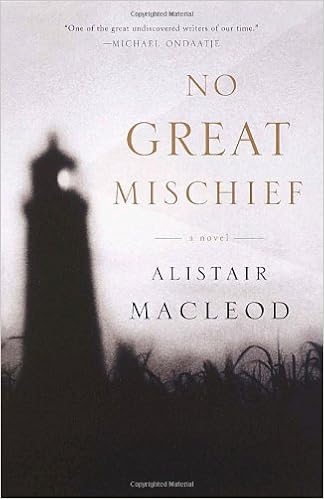
Image result for no great mischief

“It is difficult for a man ever to give advice to his father. Even if you try to think of him as just another man he is still your father and you are his child, regardless of how old you have become.”

Here’s a tip: If and when you come across a book with a blurb by Michael Ondaatje on the front or back cover, purchase it immediately. Like, now now. Don’t think about it. Just buy it. If you can’t afford it, then heed the goodly and nicely advice of Abbie Hoffman, whose 1971 book title says it all – Steal This Book.

Alistair MacLeod’s 1999 prize-winning novel No Great Mischief is one of those rare works of Canadiana that does not put you to sleep. Set between Toronto, Northern Ontario and Cape Breton Island (which some readers will know painfully well from Ann-Marie MacDonald’s Fall on Your Knees), the story is a lyrical mirror of our country’s modern history and captures many of these subtleties in ways only a master craftsman can do.

What I find ironic is that reading today’s Quote of the Day once again reminded me of – guess who! – Michael Ondaatje (and he’s got a blurb on Mr. MacLeod’s book cover in this version), and one of his innumerable pieces of prose that not only rocked my world the first time I read it in his memoir Running in the Family, but provided the opening to the eulogy I delivered at my father’s funeral years ago:

“Words such as love, passion, duty, are so continually used they grow to have no meaning – except as coins or weapons. Hard language softens. I never knew what my father felt of these “things.” My loss was that I never spoke to him as an adult.”

Leave a comment

Filed under Uncategorized

Quote of the Day

Image result for heart of darkness

“Droll thing life is – that mysterious arrangement of merciless logic for a futile purpose. The most you can hope from it is some knowledge of yourself – that comes too late – a crop of unextinguishable regrets. I have wrestled with death. It’s the most unexciting contest you can imagine. It takes place in an impalpable greyness, with nothing underfoot, with nothing around, without spectators, without clamour, without glory, without the great desire for victory, without the great fear of defeat, in a sickly atmosphere of tepid scepticism, without much belief in your own right, and still less in that of your adversary. If such is the form of ultimate wisdom, then life is a greater riddle than some of us think it to be.”

Joseph Conrad, Heart of Darkness

Good ol’ “Say It Ain’t So” Joe published Heart of Darkness in 1899, the same year Ernest Hemingway was born (the two authors would share very similar experiences in their youth, similarly influencing their respective literary content, if through different styles). The Scramble for Africa by European imperialists was at its zenith, the world was on the brink of a new century, and mankind was on a dangerous precipice, about to plunge itself into what was soon to be – up until then – the most barbaric war in human history.

Cue the background for a novel that would gain a huge resurgence in popularity after the release of  Francis Ford Coppola’s Apocalypse Now in 1979. Conrad had been deeply scarred by his experiences in Africa and harnessed these feelings in Marlow’s legendary trip along the Congo River to meet a mysterious man named Mr. Kurtz, the same theme of which would be mirrored in Coppola’s epic Vietnam War film through Captain Willard (Martin Sheen) when he sails upriver towards Cambodia to “terminate with extreme prejudice” Colonel Kurtz (Marlon Brando), whom the U.S. Army has deemed insane.

What I find most impressive about Joseph Conrad is not the canon of literature he bequeathed to posterity, but the fact that he wrote his most notable fiction in neither his first, second or third languages (Polish, Russian and French,  respectively) nor in his fourth or fifth (written) languages (Latin and German) and not even in his frigging sixth or seventh (passable but not perfectly fluent) languages (Spanish and Italian).

No, no, no. If you guessed anywhere from languages one through seven you are clearly a literary hayseed and should therefore burn with shame, languish, and be gone!

In fact, Conrad wrote his most enduring stories and prose in his freaking eighth (one after 7 and one before 9, which as it turned out was Malay) language! Perhaps more incredibly, if that’s possible, is that he he only started learning English in his 20s – and not formally in school or by living in a country like England, but on the high seas while hanging out with fellow shipmates. Hey Zeus!

And people think Leonardo da Vinci was special? That dude ain’t got nuttin’ on Joey C.

Leave a comment

Filed under Uncategorized